
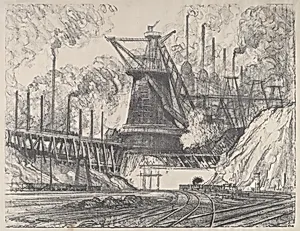
The Big Mill, Gary, Indiana
1915
Medium
lithograph in black
Dimensions
image: 44.3 × 57.2 cm (17 7/16 × 22 1/2 in.) sheet: 47 × 62.9 cm (18 1/2 × 24 3/4 in.)
Classification
Department
CG-W
Museum
National Gallery of Art, Washington, D.C.
Credit
Reba and Dave Williams Collection, Gift of Reba and Dave Williams
Accession Number
2008.115.3885
Rights
Public Domain
Art Historical Context
Joseph Pennell's *The Big Mill, Gary, Indiana* (1915) captures the monumental scale of America's industrial heartland through a striking black lithograph. Pennell, a leading figure in early 20th-century American printmaking, was renowned for his dramatic depictions of factories, bridges, and urban landscapes, emphasizing their raw power and architectural grandeur. Here, the massive steel mill Gary— a city founded just a decade earlier by U.S. Steel—looms as a symbol of Progressive Era industrialization, its towering smokestacks and vast machinery evoking both awe and the era's relentless progress. Printed in black ink on a sheet measuring 47 × 62.9 cm, this lithograph showcases Pennell's mastery of the medium. Lithography, with its greasy crayon technique on stone, allowed for rich tonal contrasts and intricate details, rendering the mill's billowing smoke and intricate structural forms with bold, expressive lines. Pennell's on-site sketching directly from such scenes lent authenticity and immediacy to his work. Housed in the National Gallery of Art as part of the Reba and Dave Williams Collection, *The Big Mill* reflects a pivotal moment when artists began celebrating—or critiquing—America's machine age. It's a vivid window into Gary's rise as a steelmaking powerhouse, inviting visitors to ponder the human ingenuity behind these iron giants.
About the Artist
Joseph Pennell · 1857–1926
Joseph Pennell (1857–1926) was born in Philadelphia to Quaker parents and displayed an early aptitude for drawing, finding solace in sketching amid a challenging childhood. He received initial drawing instruction from James R. Lambdin and his first etching lessons from Stephen Ferris in 1879. Pennell attended night classes at the Pennsylvania Museum and School of Industrial Art before studying at ...