
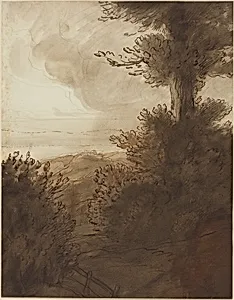
The Big Tree
1826 to 1850
Medium
pen and brown ink with brown wash over graphite on laid paper
Dimensions
overall (approximate): 40.8 x 31.9 cm (16 1/16 x 12 9/16 in.)
Classification
Drawing
Department
CG-E
Museum
National Gallery of Art, Washington, D.C.
Credit
Rosenwald Collection
Accession Number
1943.3.5507
Rights
Public Domain
Art Historical Context
Nestled in the National Gallery of Art's Rosen Collection, *The Big Tree* is a captivating drawing by French-born artist Alphonse Legros1837–1911), dated between 1826 and 1850. Rendered on laid paper—a traditional support prized for its texture and durability—this work measures approximately 40.8 x 31.9 cm and exemplifies Legros's early mastery of landscape studies. Though the date precedes his birth, it likely reflects the paper's origin or stylistic influences from that Romantic era, when nature was celebrated as a sublime force. Legros, a key figure in 19th-century Realism and the etching revival, employed pen and brown ink with brown wash over graphite to evoke the monumental presence of the towering tree. The graphite underdrawing provides precise structural lines, while the ink and wash add depth, shadow, and atmospheric mood, creating a sense of scale and quiet grandeur. This mixed-media technique, common in preparatory sketches, highlights Legros's skill in capturing light filtering through foliage, bridging Romantic reverence for nature with emerging Realist precision. As a study from his formative years, *The Big Tree* offers insight into Legros's transition from French academic training to his influential career in Britain, where he taught at the Slade School. Visitors will appreciate its intimate scale and tactile quality, inviting contemplation of nature's enduring power in an industrializing age. (198 words)
About the Artist
Alphonse Legros · 1837–1911
Alphonse Legros (1837–1911) was born in Dijon, France, and trained in Paris at the drawing school of Horace Lecoq de Boisbaudran, whose unconventional teaching method — which emphasised memory drawing and acute observation over academic convention — would leave a lasting mark on Legros's practice. At Lecoq's school he formed friendships with Jules Dalou and Auguste Rodin that endured throughout hi...