
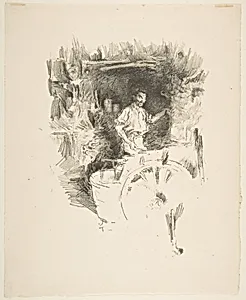
The Blacksmith
1895–96
Medium
Transfer lithograph with stumping; third state of three (Chicago); printed in black ink on medium weight cream laid paper
Dimensions
Image: 8 11/16 × 6 9/16 in. (22 × 16.7 cm) Sheet: 11 × 9 in. (27.9 × 22.9 cm)
Classification
Prints
Department
Drawings and Prints
Museum
Metropolitan Museum of Art, New York, NY
Credit
Harris Brisbane Dick Fund, 1917
Accession Number
17.3.229
Rights
Public Domain
Tags
Art Historical Context
James McNeill Whistler *The Blacksmith* (5–96) captures the raw power and rhythm of manual labor through the image of a solitary male figure at his forge. Created during the artist’s later career, this print reflects Whistler’s fascination with everyday workers, elevating their toil into a study of form, light, and movement. Known for his Aesthetic movement principles—prioritizing harmony and beauty over narrative—Whistler transformed gritty subjects like blacksmiths into compositions, distancing himself from Victorian sentimentality. Executed as a transfer lithograph with stumping, the work showcases Whistler’s mastery of printmaking. He drew on transfer paper, which was then offset onto a lithographic stone, allowing for rich tonal variations. Stumping—a technique using a soft stump to blend and smooth graphite-like tones—creates subtle gradations in the black ink on cream laid paper, mimicking the glow of firelight and muscular strain. This third (and final) state, associated with the Chicago variant, represents the refined culmination of the edition. Housed in the Metropolitan Museum of Art’s Drawings and Prints department since 1917, thanks to the Harris Brisbane Dick Fund, *The Blacksmith* highlights lithography’s role in democratizing art. At just 8 11/16 × 6 9/16 inches, it invites close contemplation of Whistler’s innovative approach to industrial-age life, blending realism with poetic abstraction.
About the Artist
James McNeill Whistler · 1834–1903
James Abbott McNeill Whistler (1834-1903) was an American-born painter and printmaker who became a leading figure in the Aesthetic Movement and pioneer of Tonalism and Japonisme. He revolutionized art by championing "art for art's sake" and treating paintings as visual equivalents of musical compositions, titling works as "arrangements," "harmonies," and "nocturnes" to emphasize formal qualities o...