
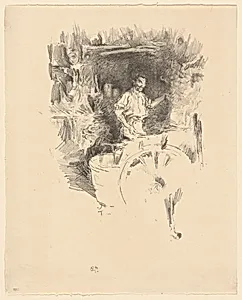
The Blacksmith
1895/96
Medium
Transfer lithograph in black, with stumping, on cream laid paper
Dimensions
Image: 22 × 16.7 cm (8 11/16 × 6 5/8 in.); Sheet: 28.2 × 22.8 cm (11 1/8 × 9 in.)
Classification
transfer lithograph
Department
Prints and Drawings
Museum
Art Institute of Chicago
Accession Number
73855
Rights
Public Domain
Art Historical Context
James McNeill Whistler’s *The Blacksmith* (1895/96) captures the quiet intensity of labor in a transfer lithograph on cream laid paper, measuring a modest 22 × 16.7 cm for the image. Created late in the artist’s career, this print reflects Whistler’s mastery of printmaking during a period when he increasingly turned to lithography to explore everyday subjects with poetic subtlety. As a key figure in the Aesthetic movement,istler championed “art for art’s sake prioritizing harmony of tone and form over narrative, and this work exemplifies his ability to elevate the mundane into something timeless. The medium—a transfer lithograph in black with stumping—highlights innovative techniques. Whistler drew the image on transfer paper before pressing it onto a lithographic stone, allowing precise control over subtle gradations. Stumping, a blending method using a soft tool like leather or rubber, softens harsh lines into velvety tones, mimicking the sfumato effects of old masters while evoking the forge’s smoky atmosphere. This print, housed in the Art Institute of Chicago’s Prints and Drawings department, showcases lithography’s democratic appeal in the 1890s, making fine art accessible beyond oil paintings. Whistler produced numerous lithographs in his final years, often depicting workers and urban vignettes, blending realism with impressionistic mood. *The Blacksmith* invites viewers to ponder the dignity of craft amid industrial change, a subtle nod to Victorian-era social shifts. A gem for print enthusiasts!
About the Artist
James McNeill Whistler · 1834–1903
James Abbott McNeill Whistler (1834-1903) was an American-born painter and printmaker who became a leading figure in the Aesthetic Movement and pioneer of Tonalism and Japonisme. He revolutionized art by championing "art for art's sake" and treating paintings as visual equivalents of musical compositions, titling works as "arrangements," "harmonies," and "nocturnes" to emphasize formal qualities o...