
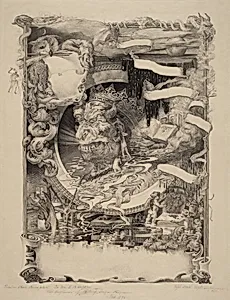
The Bookplate of the Printer's Devil
Medium
engraving on wove paper
Dimensions
plate: 30.3 x 36.9 cm (11 15/16 x 14 1/2 in.) sheet: 36.9 x 27.9 cm (14 1/2 x 11 in.)
Classification
Department
CG-W
Museum
National Gallery of Art, Washington, D.C.
Credit
Ailsa Mellon Bruce Fund
Accession Number
2008.1.4
Rights
Public Domain
Art Historical Context
Created in 1896 by Francis Scott King, *The Bookplate of the Printer’s Devil* is a finely detailed engraving on wove paper that celebrates the world of printing and book collecting. Bookplates—small labels pasted inside book covers to mark ownership—were especially popular in the late nineteenth century, when private libraries flourished and collectors sought personalized emblems. The intriguing title refers to the traditional “printer’s devil,” the young apprentice who performed odd jobs in a print shop, often depicted as a mischievous figure surrounded by type and presses. King’s choice of engraving allowed for crisp lines and delicate tonal effects, qualities well suited to the intimate scale of a bookplate. Measuring roughly 12 by 15 inches in the plate, the work balances precision with decorative flair, reflecting the era’s renewed interest in fine printing and the book arts. Acquired by the National Gallery of Art through the Ailsa Mellon Bruce Fund, the print preserves a charming tribute to the craftsmen who brought books to life.
About the Artist
Francis Scott King · 1850–1913
**Francis Scott King (1850–1913) was an American engraver, printmaker, and painter known for his intricate bookplates and wood engravings, as well as works in oil depicting figures, genre scenes, and still lifes.** Born in Auburn, Maine, he spent much of his career working in New York before his death in Newark, New Jersey. King specialized in detailed printmaking techniques, producing finely cra...