
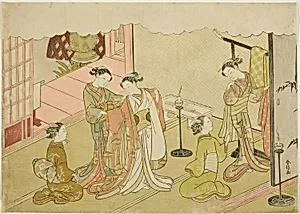
The Bride Changing Clothes (Iro-naoshi), the fifth sheet of the series "Marriage in Brocade Prints, the Carriage of the Virtuous Woman (Konrei nishiki misao-guruma)"
c. 1769
Medium
Color woodblock print; chuban yoko-e
Dimensions
20.1 × 28 cm (7 7/8 × 11 in.)
Classification
woodblock print
Department
Arts of Asia
Museum
Art Institute of Chicago
Accession Number
21141
Rights
Public Domain
Art Historical Context
Suzuki Harunobu's *The Bride Changing Clothes (ro-naoshi)*, around 1769, captures a tender moment from Japanese wedding traditions as the fifth sheet in his series *Marriage in Brocade, the Carriage of Virtuous Woman (Konrei nishikiao-guruma)*. This color woodblock print, in the intimate chuban yoko-e (horizontal, about 20 × 28 cm), depicts the bride transitioning from her white shiromuku wedding kimono to a vibrant, colorful outfit—a ritual called *iro-naoshi* symbolizing her new life as a married woman. Harunobu, a master of ukiyo-e ("pictures of the floating world"), pioneered full-color nishiki-e prints in the 1760s, bringing Edo-period Japan's everyday beauty and customs to life with unprecedented vibrancy. Printed during Japan's Edo era (1603–1868), when woodblock prints democratized art for urban audiences, this piece reflects the cultural reverence for marriage as a virtuous journey. Harunobu's signature style shines through delicate lines, subtle gradations (*bokashi*), and lush colors achieved via multiple woodblocks, evoking intimacy and elegance. Held in the Art Institute of Chicago's Arts of Asia collection, it offers visitors a window into 18th-century domestic rituals and the artistry that elevated them to timeless treasures.
About the Artist
Suzuki Harunobu · 1725–1770
Suzuki Harunobu (c. 1725-1770) was a Japanese ukiyo-e artist who revolutionized woodblock printing by developing nishiki-e—full-color prints using multiple woodblocks—in 1765. Before Harunobu, Japanese prints were limited to two or three colors; his innovation unleashed the entire artist's palette, transforming ukiyo-e into the vibrant art form that would later captivate Western artists from Manet...