
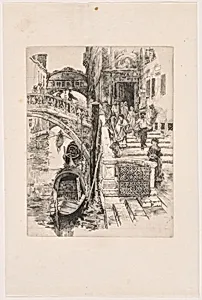
The Bridge of Sighs (Second Plate)
1885
Medium
Etching in black on ivory Japanese paper
Dimensions
Plate: 28.7 × 22.2 cm (11 5/16 × 8 3/4 in.); Sheet: 44.6 × 29.6 cm (17 9/16 × 11 11/16 in.)
Classification
prints and drawing
Department
Prints and Drawings
Museum
Art Institute of Chicago
Accession Number
261638
Rights
Public Domain
Art Historical Context
Frank Duveneck's *The Bridge of Sighs (Second Plate)* (1885) captures the iconic Venetian landmark that links the Doge's Palace to the old prison, evoking whispers of history and romance. Created during Duveneck's time in Venice as part of his expatriate phase, this etching reflects the late 19th-century fascination among American artists with Europe's architectural treasures. Duveneck, a Realist painter and printmaker influenced by the Munich school, turned to etching in the 1880s to document atmospheric cityscapes with bold, expressive lines. Printed in black ink on luxurious ivory Japanese paper, the work showcases etching's intaglio technique, where acid etches intricate details into a metal plate for rich tonal depth. The choice of Japanese paper— prized for its soft texture and ability to hold fine ink—enhances the print's velvety shadows and subtle highlights, making this second plate in a series particularly intimate. Measuring 28.7 × 22.2 cm on the plate, it invites close viewing. Housed in the Art Institute of Chicago's Prints and Drawings department, this piece highlights Duveneck's mastery in translating Venice's moody canals and stone arches into enduring prints, bridging 19th-century travelogue artistry with technical innovation. A must-see for lovers of urban romance!
About the Artist
Frank Duveneck · 1848–1919
Frank Duveneck (1848–1919) was an American painter, etcher, and teacher whose dark, bravura style made him one of the most celebrated and influential American artists of the late nineteenth century. Born in Covington, Kentucky, he showed early artistic promise and eventually made his way to Munich, where he studied at the Royal Academy of Fine Arts under Wilhelm von Diez. Munich's artistic culture...