
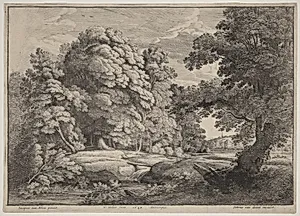
The Bridge over the Waterfall
Medium
etching on laid paper
Dimensions
plate: 14.9 x 21 cm (5 7/8 x 8 1/4 in.) sheet: 15 x 21 cm (5 7/8 x 8 1/4 in.)
Classification
Department
CG-E
Museum
National Gallery of Art, Washington, D.C.
Credit
Gift of the Estate of Leo Steinberg
Accession Number
2011.139.26
Rights
Public Domain
Art Historical Context
Welcome to the National Gallery of Art, where *The Bridge over the Waterfall (1648) invites you into a serene 17th-century landscape. This delicate etching on laid paper, measuring about 15 x 21 cm, was created by masterful Bohemian printmaker Wenceslaus Hol after an original composition by Flemish Baroque artist Jacques d'Artois.lar, renowned for his reproductive prints, captures d'Artois' idyllic scene of a stone bridge arching gracefully over cascading water, framed by lush foliage and distant hills—evoking the harmonious naturalism of Flemish landscape traditions. Etching, Hollar's preferred medium, allowed for intricate lines and tonal subtleties on laid paper, a handmade support with visible chain lines that was standard for fine prints of the era. Produced in Antwerp around 1648, amid the waning Thirty Years' War, this work reflects the era's escapist delight in pastoral beauty, translating d'Artois' painterly brushstrokes into enduring graphic precision. Hollar's over 2,500 known prints made complex artworks accessible, bridging painting and printmaking. A generous gift from the Estate of Leo Steinberg, this piece highlights the technical virtuosity of 17th-century etching and the cultural allure of imagined rural retreats. Pause here to appreciate how Hollar's needle revives d'Artois' vision, frozen in time for us today.