
The Broken Crock
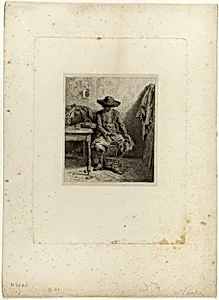
Medium
Etching on light gray China paper laid down on ivory wove paper
Dimensions
Image: 10.9 × 9.3 cm (4 5/16 × 3 11/16 in.); Chine: 11.8 × 9.9 cm (4 11/16 × 3 15/16 in.); Plate: 21.5 × 15.8 cm (8 1/2 × 6 1/4 in.); Sheet: 30.7 × 22.3 cm (12 1/8 × 8 13/16 in.)
Classification
etching
Department
Prints and Drawings
Museum
Art Institute of Chicago
Accession Number
133668
Rights
Public Domain
Art Historical Context
Charles Émile Jacque's * Broken Crock* (184) captures the humble essence of rural French life through the intimate medium of etching. key figure in the Barb School, Jacque specialized in pastoral scenes featuring peasants animals, and everyday objects, reflecting the Realism movement shift away from idealized Romanticism toward authentic depictions of the countryside. This print, housed in the Art Institute of Chicago's Prints Drawings department, likely centers on a shattered earthenware pot—a poignant symbol of fragility and toil in 19th-century agrarian societyPrinted on delicate light gray China paper ( thin, absorbent Japanese import prized for its velvety texture) and laid down on sturdy ivory wove paper, the work showcases Jacque's mastery of etching. This intaglio technique, where acid etches intricate lines into a metal plate, allowed for rich tonal contrasts and fine details, making it ideal for evoking texture in humble subjects like cracked pottery or weathered surfaces. The modest image size (10.9 × 9.3 cm) invites close viewing, emphasizing the print's role in democratizing art during an era when affordable reproductions brought fine artistry to wider audiences. Jacque's etching not only highlights technical innovation but also cultural nostalgia for pre-industrial simplicity, bridging fine art and popular imagery in mid-19th-century France. A gem for print enthusiasts, it reminds us of art's power to elevate the ordinary.