
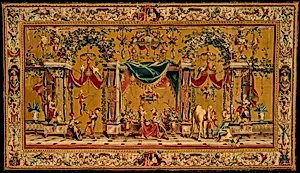
The Camel from a set of five Grotesques
designed ca. 1688, woven ca. 1690–1711
Medium
Wool, silk (21-27 warps per inch, 8-9 per cm.)
Dimensions
9 ft. 10 in. × 17 ft. 4 1/2 in. (299.7 × 529.6 cm)
Classification
Textiles-Tapestries
Culture
French, Beauvais
Department
European Sculpture and Decorative Arts
Museum
Metropolitan Museum of Art, New York, NY
Credit
Gift of John M. Schiff, 1977
Accession Number
1977.437.1
Rights
Public Domain
Tags
Art Historical Context
Step into the exuberant world of late 17th-century French arts with *The Camel from a Set Five Grotesques*, magnificent tapestry woven at the renowned Beauvais manufactory. Designed around 1688 by court artists Jean Berain, celebrated for his intricate arabesques and ornamental fantasies, alongside floral master Jean-Baptiste Monnoyer Guy Louis Vernansal Elder, and Philippe Béhagle, it was hand-woven between 1690 and 1711. Measuring nearly 10 by 17 feet, this wool-and-silk masterpiece boasts a fine weave of 21-27 warps per inch, showcasing the technical virtuosity of Beauvais weavers who produced lighter, more vibrant tapestries than their Gobelins counterparts. The panel bursts with grotesque motifs—a whimsical Renaissance revival style blending fantastical creatures and playful scenes. At its heart, a majestic camel anchors a lively tableau of dancing figures, acrobats, sphinxes, leopards, birds, abundant fruits, and blooming flowers, populated by men and women in joyous abandon. These intricate designs, inspired by ancient Roman frescoes, reflect the opulent tastes of Louis XIV's Versailles era, where tapestries adorned grand châteaux as symbols of power and refinement. A generous gift to the Metropolitan Museum of Art in 1977, this tapestry highlights France's golden age of textile innovation, inviting us to marvel at its enduring splendor and the collaborative genius behind such lavish artistry.
About the Artist
Jean Berain|Guy Louis Vernansal the Elder|Philippe Béhagle|Jean-Baptiste Monnoyer|Beauvais|Jean-Baptiste Monnoyer · 1640–1711
**Jean Bérain the Elder (1640–1711)** was a French draughtsman, designer, painter, and engraver of ornament who served as the central artistic force in the Royal office of the Menus-Plaisirs du Roi. Born in Saint-Mihiel in the Spanish Netherlands (now France) to a master gunsmith, he spent his career in Paris and became one of the defining figures of late 17th-century French decorative arts. Béra...