
The Capitol, Rome
1922
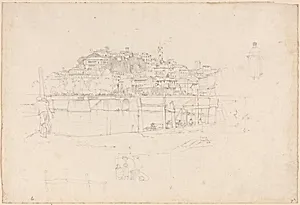
Medium
graphite on laid paper
Dimensions
overall: 23 x 33.7 cm (9 1/16 x 13 1/4 in.)
Classification
Drawing
Department
CG-W
Museum
National Gallery of Art, Washington, D.C.
Credit
Rosenwald Collection
Accession Number
1943.3.959
Rights
Public Domain
Art Historical Context
Robert Austin's "The Capitol, Rome" (1922) presents a measured view of one of the Eternal City's most storied landmarks. Rendered in graphite on laid paper, the drawing measures just 23 by 33.7 centimeters, a compact format that suggests it may have been created on-site during the artist's travels. The choice of medium allows for crisp architectural lines alongside soft tonal gradations that capture the play of light across stone surfaces. As a work now held in the National Gallery of Art's Rosenwald Collection, the piece reflects the early twentieth-century interest in classical sites through intimate, portable drawing rather than large-scale painting. Graphite on laid paper was favored by many artists of the period for its ability to record precise details while remaining responsive to subtle atmospheric effects. Visitors can appreciate how the restrained palette and textured support invite close looking, encouraging reflection on Rome's layered history and the enduring appeal of its monuments to modern eyes.
About the Artist
Robert Austin · 1895–1973
Robert Sargent Austin RA PPRWS PPRE (1895–1973) was a preeminent British engraver, draughtsman, illustrator, and painter, born in Leicester, England, where his prodigious talent emerged early—at just eight years old, he exhibited with the Royal Drawing Society.) He trained first at the Leicester Municipal School of Art from 1909 to 1913, then at the Royal College of Art from 1914–1916 and 1919–192...