
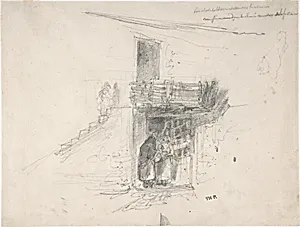
Two Women Talking in a Doorway
1830–31
Medium
Graphite on laid paper
Dimensions
6 1/2 x 8 1/2 in. (16.5 x 21.6 cm)
Classification
Drawings
Department
Drawings and Prints
Museum
Metropolitan Museum of Art, New York, NY
Credit
Gift of Jill Newhouse, in honor of Karen B. Cohen, 2000
Accession Number
2000.419
Rights
Public Domain
Tags
Art Historical Context
In the intimate drawing *Two Women Talking in away* (1830–31), Théodore Rousseau captures a fleeting moment of everyday life with graphite on laid paper. Measuring just 6½ × 8½ inches, this modest sheet exemplifies the French artist's early mastery of quick, observational sketches. Rousseau, a leading figure in the Barbizon, rejected the polished idealism of academic art in favor of direct studies from nature, often made en plein air during his countryside wanderings near Fontainebleau Forest. The scene's doorway framing—echoed in the artwork's tags—highlights Rousseau's fascination with humble rural architecture and human activity within it. Rendered in soft graphite lines on textured laid paper, the work reveals his technique of building form through subtle tonal variations and loose hatching, prioritizing authenticity over finish. Created amid France's post-Revolutionary shifts toward Romantic realism, it foreshadows the artist's later monumental landscapes and the Impressionists' emphasis on candid, light-filled vignettes. Today, this gem resides in the Metropolitan Museum of Art's Drawings and Prints department, a 2000 gift from Jill Newhouse honoring Karen B. Cohen. It invites visitors to appreciate how Rousseau's sketches bridged meticulous draftsmanship with the poetry of ordinary moments.
About the Artist
Théodore Rousseau · 1812–1867
Théodore Rousseau (1812–1867) was a French landscape painter and the leading figure of the Barbizon School, the group of artists who settled in the village of Barbizon near the Forest of Fontainebleau to paint directly from nature. Born in Paris, he showed precocious talent and studied under the academic painters Charles Rémond and Guillaume Guillon-Lethière, but quickly rejected classical landsca...