
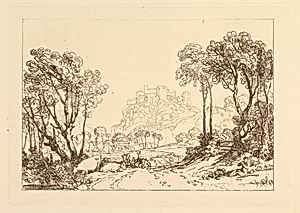
The Castle above the Meadows (Liber Studiorum, part II, plate 8)
Medium
Etching; before first state of four
Dimensions
plate: 7 x 10 1/4 in. (17.8 x 26 cm) sheet: 8 1/16 x 11 3/8 in. (20.5 x 28.9 cm)
Classification
Prints
Department
Drawings and Prints
Museum
Metropolitan Museum of Art, New York, NY
Credit
Gift of Theodore De Witt, 1917
Accession Number
17.22.21
Rights
Public Domain
Tags
Art Historical Context
Joseph Mallord William Turner, the preeminent British Romantic landscape artist, created *The Castle above the Meadows in 1808 as Plate 8 from Part II of his ambitious *Liber Studiorum series. Launched in 1807 and continuing until 1819, collection of 71 etched and mezzotint landscapes drew inspiration from the 17th-century French artist Claude Lorrain'sLiber Veritatis*. Turner categorized his prints into poetic themes—such as mountainous, pastoral, and architectural—to demonstrate the full range of landscape possibilities, blending observation with imaginative grandeur. This early work exemplifies his "pastoral" or "architectural" mode, evoking a harmonious, idyllic English countryside. Printed as an etching in its rare "before first state" proof—prior to added mezzotint shading for tonal depth—the plate measures a compact 7 x 10¼ inches. Turner's innovative technique allowed him to capture atmospheric light and subtle textures, even in black-and-white, foreshadowing his later watercolor mastery. Elements like trees and animals in the meadows ground the scene in natural vitality, with the distant castle perched dramatically above, symbolizing human endeavor amid sublime nature. Acquired as a gift to the Metropolitan Museum of Art in 1917, this print highlights Turner's pivotal role in elevating printmaking to fine art, influencing generations of artists. Visitors will appreciate its serene composition, a window into early 19th-century Romantic reverence for the British landscape.
About the Artist
Joseph Mallord William Turner · 1775–1851
Joseph Mallord William Turner, born on 23 April 1775 in London's Covent Garden to barber William Turner and Mary Marshall, emerged as a child prodigy amid personal hardships. His mother suffered mental illness and died in Bethlem Hospital in 1804, while his father supported his early sketches by displaying them in his shop. Around age 10, Turner stayed with his uncle Joseph Mallord William Marshal...