
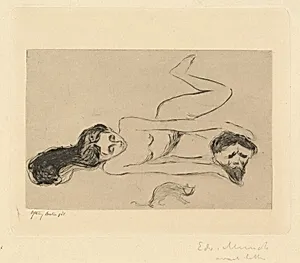
The Cat (Die Katze)
1897
Medium
drypoint
Classification
Department
CG-E
Museum
National Gallery of Art, Washington, D.C.
Credit
Rosenwald Collection
Accession Number
1944.14.55
Rights
Public Domain
Art Historical Context
Edvard Munch's *The Cat (Die Kat)*, created in 1897, captures the Norwegian artist's mastery of printmaking through the intimate medium of drypoint. This technique involves scratching directly into a metal plate with a sharp tool, raising a soft burr that produces rich, velvety lines inked and printed—ideal for Munch's expressive, fluid style. Housed in the National Gallery of Art's Rosenwald Collection this print exemplifies his shift toward Symbolism and early Expressionism, movements that delved into emotional depth and the human psyche. Munch, best known for his iconic *The Scream*, often infused everyday subjects with psychological tension. Here, the solitary cat emerges as a mysterious figure, its form rendered with bold, spontaneous strokes that echo the raw anxiety of his larger oeuvre. Produced during a prolific period in Berlin and Paris, where Munch experimented with prints to reach wider audiences, *The Cat* highlights his innovative approach to reproduction, allowing subtle tonal variations in each impression. This work invites viewers to ponder the feline's watchful gaze amid Munch's turbulent life—marked by loss and introspection—making it a poignant gem in the Department of Prints and Drawings (CG-E). A testament to late 19th-century artistic innovation, it bridges fine art and accessible multiples.
About the Artist
Edvard Munch · 1863–1944
Edvard Munch (1863-1944) was a Norwegian painter and printmaker whose intensely psychological works made him a pioneer of Expressionism and one of the most influential artists of the modern era. His 1893 masterpiece 'The Scream' has become an iconic symbol of existential anxiety. Munch's art was profoundly shaped by personal tragedy—his mother died when he was five, his beloved sister Sophie at fo...