
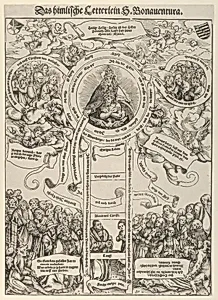
The Celestial Ladder of St. Bonaventura
Medium
Woodcut; state one of two (Hollstein)
Dimensions
Sheet: 16 1/4 × 11 5/8 in. (41.2 × 29.5 cm)
Classification
Prints
Department
Drawings and Prints
Museum
Metropolitan Museum of Art, New York, NY
Credit
Harris Brisbane Dick Fund, 1937
Accession Number
37.43.5
Rights
Public Domain
Tags
Art Historical Context
Behold *The Celestial Ladder of St Bonaventura*, a woodcut by Lucas Cranach the Elder, of the foremost German Renaissance artists active in the early 16th century. for his vivid religious imagery and close ties to the Saxon court Wittenberg, Cranach woodcuts as a medium for disseminating art widely during the Reformation era. This print, from the first of two states cataloged by Hollstein, measures 16¼ × 11⅝ inches and captures a dynamic vision of spiritual ascent, featuring angels, men, women, saints gathered around a towering ladder symbolizing the path to heaven. The title draws from the mystical writings of St. Bonaventure (1221–1274), the influential Franciscan theologian whose visions often depicted ladders as metaphors for divine grace and moral virtues leading the soul upward. Cranach's composition likely illustrates such a celestial hierarchy, blending Northern Renaissance detail with symbolic depth—angels guiding figures in a rhythmic climb evokes the era's fascination with salvation amid religious upheaval. As a testament to early printmaking innovation, this woodcut allowed affordable multiples for devotional use in homes and churches. Acquired through the Harris Brisbane Dick Fund in 1937, it now graces the Metropolitan Museum of Art's Drawings and Prints department, offering visitors a window into Cranach's prolific output and the cultural fervor of Renaissance Europe.
About the Artist
Lucas Cranach the Elder · 1472–1553
Lucas Cranach the Elder (c. 1472-1553) was one of the most prominent German Renaissance painters and a key artistic figure of the Protestant Reformation. Born in Kronach, Franconia, to the painter Hans Maler, Cranach began his career in Vienna around 1502, where he became one of the founders of the Danube School, a movement characterized by expressive landscape painting and emotional force. His ea...