
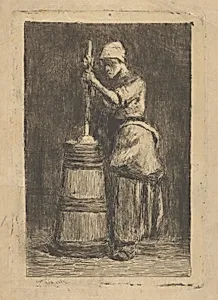
The Churner
Medium
Etching
Dimensions
sheet: 9 7/16 x 6 5/8 in. (23.9 x 16.8 cm) plate: 7 5/8 x 5 3/8 in. (19.4 x 13.6 cm) image: 7 1/16 x 4 1/2 in. (17.9 x 11.5 cm)
Classification
Prints
Department
Drawings and Prints
Museum
Metropolitan Museum of Art, New York, NY
Credit
A. Hyatt Mayor Purchase Fund, Marjorie Phelps Starr Bequest, 1982
Accession Number
1982.1087.4
Rights
Public Domain
Tags
Art Historical Context
The Churner captures the quiet dignity of rural labor through the figure of a woman intently working a butter churn. Created around 1886 as an etching measuring roughly 7 by 5 inches in the plate, the print emphasizes the repetitive motion and humble setting of domestic work. The medium’s fine, controlled lines allow delicate modeling of the figure’s posture and the textures of her clothing and tools, inviting viewers to appreciate both the physical effort and the meditative rhythm of the task. This subject reflects the nineteenth-century fascination with scenes of peasant and working life, a theme central to Jean-François Millet’s realist vision. William Merritt Chase, an American artist known for his fluid brushwork and later Impressionist leanings, translated such motifs into the intimate language of etching. The result highlights the enduring cultural value placed on women’s labor while demonstrating how printmaking made these images widely accessible to new audiences in the late 1800s.
About the Artist
William Merritt Chase|Jean-François Millet · 1849–1916
Prolific painter of portraits, interiors, still lifes and landscapes, famed for establishing the fresh colour and bravura technique used in much early 20th-century American painting. He was considered the most important American teacher of his time; after teaching at the Art Students League of NY he formed the Chase School of Art in 1896. Comment on works: genre, Portraits