
Woman with a Churn
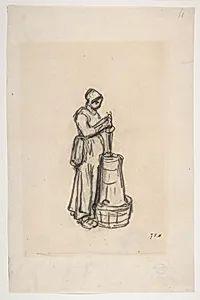
Medium
Conté crayon on wove paper
Dimensions
11 1/4 x 7 5/16 in. (28.6 x 18.5 cm)
Classification
Drawings
Department
Drawings and Prints
Museum
Metropolitan Museum of Art, New York, NY
Credit
Gift of Miss Mary W. Tweed, 1929
Accession Number
29.93.3
Rights
Public Domain
Tags
Art Historical Context
Jean-François Millet's *Woman with a Churn (1854) captures the quiet dignity of rural French peasant life, a central theme in the artist's oeuvre. As a leading figure in the Realist movement and the Barbizon School, elevated everyday laborers—often overlooked in academic art—to heroic status. Created during a period when he was deeply immersed in depicting the hardships and routines of farm workers in Barbizon, this drawing portrays a woman absorbed in the laborious task of churning butter, symbolizing the resilience of the working class amid France's social upheavals post-1848 Revolution. Rendered in Conté crayon on wove paper—a smooth, versatile support ideal for subtle tonal modeling—Millet masterfully employs the medium's rich blacks and grays to convey texture and light. The intimate scale (11 1/4 x 7 5/16 in.) suggests it as a preparatory study, showcasing his economical yet expressive line work and mastery of chiaroscuro, which imbues the figure with emotional depth and three-dimensionality. Housed in the Metropolitan Museum of Art's Drawings and Prints department (gift of Miss Mary W. Tweed, 1929), this work highlights women's pivotal role in agrarian society. Millet's empathetic gaze challenged romanticized ideals, influencing later artists like Van Gogh and paving the way for modern depictions of labor. A poignant glimpse into 19th-century rural France, it invites visitors to appreciate the artistry in the ordinary.
About the Artist
Jean-François Millet · 1814–1875
Jean-François Millet (1814-1875) was a French painter and one of the founders of the Barbizon school, whose dignified depictions of peasant laborers transformed how art could represent rural life. His monumental images of sowers, gleaners, and field workers elevated common people to subjects previously reserved for mythological or historical figures, making him a pivotal figure in the development ...