
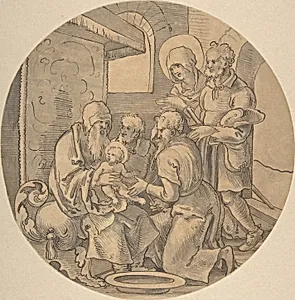
The Circumcision of Christ
1510–50
Medium
Pen and brown ink, brush and gray wash, over black chalk
Dimensions
Diameter 22.3 cm. (8 3/4 in.)
Classification
Drawings
Department
Drawings and Prints
Museum
Metropolitan Museum of Art, New York, NY
Credit
Anonymous gift, 1995
Accession Number
1995.470
Rights
Public Domain
Tags
Art Historical Context
Sebald Beham’s *The Circumcision of Christ* captures a pivotal moment from the Gospel of Luke in an intimate circular format typical of the artist’s small-scale designs. Created between 1510 and 1550, the drawing shows the infant Jesus held by the Virgin Mary as a mohel performs the ritual, surrounded by male figures in period attire. Beham, one of the so-called “Little Masters” of Nuremberg, often worked on this modest size, producing both engravings and the preparatory studies that preceded them. Executed in pen and brown ink with gray wash over black chalk, the sheet reveals Beham’s precise line work and subtle tonal modeling. The circular composition concentrates attention on the central action while allowing the surrounding figures to frame the scene with quiet dignity. Such drawings frequently served as models for prints that circulated widely during the Reformation, when religious imagery was both devotional and debated. Housed in the Metropolitan Museum of Art’s Department of Drawings and Prints, this work exemplifies the refined draftsmanship of early-sixteenth-century Germany. Its modest dimensions invite close viewing, rewarding the observer with the delicate interplay of line and wash that brings a sacred narrative to life.
About the Artist
Sebald Beham · 1500–1550
Sebald Beham (1500–1550), a pioneering German printmaker and painter born in Nuremberg, emerged as one of the most prolific artists of the Northern Renaissance. The elder brother of fellow artist Barthel Beham, he grew up in a milieu steeped in artistic tradition, though details of his early training remain sparsely documented. Recorded as a journeyman painter (Malergeselle) by 1521 and a master w...