
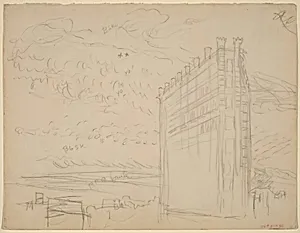
The City from Greenwich Village
c. 1922
Medium
graphite
Dimensions
overall: 19.7 x 25.6 cm (7 3/4 x 10 1/16 in.)
Classification
Drawing
Department
CG-W
Museum
National Gallery of Art, Washington, D.C.
Credit
Gift of Helen Farr Sloan
Accession Number
1971.54.2
Rights
Public Domain
Art Historical Context
John Sloan’s *The City from Greenwich Village* (c. 1922) offers a quiet yet evocative glimpse of New York at a moment of rapid transformation As a leading member of the Ashcan School, Sloan was renowned for his honest portrayals of urban, and this graphite drawing captures the city’s skyline as seen from thehemian neighborhood where he lived and worked. The small sheet—just under eight by ten inches—records the contrast between the intimate, low-rise streets of the Village and the rising towers beyond, reflecting the tension between old and new that defined the early twentieth century. Executed in graphite, the work demonstrates Sloan’s skill at using subtle shading and quick, confident lines to suggest atmosphere and distance. Rather than a finished painting, this drawing feels like a personal observation, preserving the artist’s immediate response to the changing urban landscape. Its intimate scale invites viewers to linger over the details, much as Sloan must have done while looking out over his adopted city. Donated to the National Gallery of Art by Sloan’s wife, Helen Farr Sloan, the drawing remains a treasured record of both an artist’s eye and a pivotal era in American city life.
About the Artist
John Sloan · 1871–1951
John French Sloan was born on August 2, 1871, in Lock Haven, Pennsylvania, and grew up in Philadelphia, where he taught himself to draw largely through self-study and reproductions before taking evening classes at the Pennsylvania Academy of the Fine Arts under Thomas Anshutz around 1892. That same year he met the painter Robert Henri, who became his closest friend and most influential mentor, enc...