
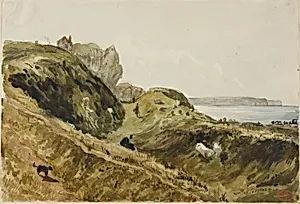
The Cliffs at Dieppe
c. 1825
Medium
Watercolor, over graphite, on ivory wove paper, tipped on cream laid paper
Dimensions
17.6 × 25.9 cm (6 15/16 × 10 1/4 in.)
Classification
watercolor
Department
Prints and Drawings
Museum
Art Institute of Chicago
Accession Number
31615
Rights
Public Domain
Art Historical Context
Paul Huet’s “The Cliffs at Dieppe,” created around 1825, offers a quiet yet evocative glimpse of the rugged northern French coastline. Rendered in watercolor over graphite on ivory wove paper, the small sheet (just under seven by ten inches) demonstrates how the medium’s fluid washes and luminous transparency could capture the shifting light and textures of sea and stone with remarkable immediacy. The choice of watercolor on paper was especially suited to landscape subjects in the early nineteenth century. Its portability allowed artists to work outdoors, while its delicate layering of color conveyed atmosphere and depth without the heavier finish of oil. Here, Huet uses these qualities to suggest the imposing presence of the cliffs rising above the water, inviting viewers to sense both their scale and their quiet drama. Now part of the Art Institute of Chicago’s collection of prints and drawings, the work reflects the period’s growing interest in natural scenery as a worthy artistic focus. Its modest size and refined technique encourage close looking, rewarding visitors with a sense of place that feels both specific and timeless.
About the Artist
Paul Huet · 1803–1869
Paul Huet was born in Paris in 1803 and emerged as one of the founding figures of French Romantic landscape painting, a pioneer who helped chart the course from the classical tradition of the previous century toward the freer, more emotionally charged approach to nature that would define the Romantic era. As a young man he studied briefly with Pierre-Henri de Valenciennes and Antoine-Jean Gros, bu...