
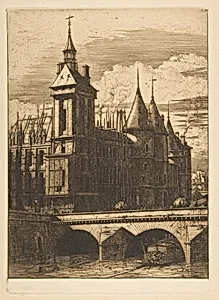
The Clock Tower, Paris
1852
Medium
Etching
Dimensions
sheet: 17 11/16 x 12 3/16 in. (45 x 31 cm)
Classification
Prints
Department
Drawings and Prints
Museum
Metropolitan Museum of Art, New York, NY
Credit
Gift of Theodore De Witt, 1917
Accession Number
17.22.19
Rights
Public Domain
Tags
Art Historical Context
Step into 19th-century Paris with Charles Meryon's *The Clock Tower, Paris* (1852), a masterful etching that captures the city's Gothic splendor on the cusp of transformation. Meryon, a pioneering French printmaker renowned for his vedute—detailed topographical views—depicts a towering clock structure amid bridges, buildings, and the urban bustle of pre-Haussmann Paris. Created just before Baron Haussmann's sweeping renovations razed much of the medieval skyline, this work preserves a vanishing architectural heritage, evoking a romantic nostalgia for old-world charm. Etching's intaglio technique shines here: Meryon scratched intricate lines into a metal plate, allowing acid to etch fine textures that render stonework, shadows, and atmospheric skies with astonishing precision. Measuring 17 11/16 x 12 3/16 inches, the print's scale invites close inspection of its architectural drama, blending realism with subtle drama. Hailed as one of the era's greatest etchers, Meryon's series on Paris influenced later artists like Whistler. Today, this gem resides in the Metropolitan Museum of Art's Drawings and Prints department, a 1917 gift from Theodore De Witt. It reminds us how prints democratized art, letting collectors savor Paris's timeless allure from afar.
About the Artist
Charles Meryon · 1821–1868
Charles Meryon, born on November 23, 1821, in Paris, was the illegitimate son of English physician Dr. Charles Lewis Meryon and dancer Pierre-Narcisse Chaspoux (stage name Narcisse Gentil) at the Paris Opéra. His half-sister Fanny, from his mother's prior relationship with Viscount Lowther, remained in contact after their mother's death in 1838. Raised partly outside Paris before attending Pension...