
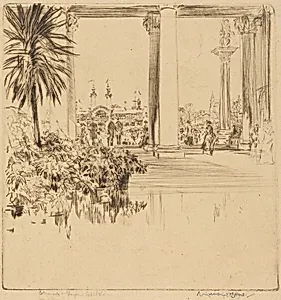
The Colonnade, Glasgow Exhibition
1901
Medium
drypoint in black
Dimensions
plate: 16.83 × 16.51 cm (6 5/8 × 6 1/2 in.)
Classification
Department
CG-W
Museum
National Gallery of Art, Washington, D.C.
Credit
Rosenwald Collection
Accession Number
1943.3.1949
Rights
Public Domain
Art Historical Context
**The Colonnade, Glasgow Exhibition** (1901) by Muirhead Bone captures the architectural splendor of one of Britain's grand international expositions. This intimate drypoint print depicts the elegant colonnade from the Glasgow International Exhibition, a lavish event held in Kelvingrove Park that showcased industrial innovation, arts, and imperial achievements to over 11 million visitors. At just 16.83 × 16.51 cm, Bone's work distills the exhibition's monumental scale into a precise, atmospheric vignette, inviting viewers to linger on its classical columns and implied grandeur. Bone, a leading Scottish artist of the early 20th century, was celebrated for his masterful prints that blended realism with subtle tonal depth, often focusing on urban and architectural subjects. Drypoint, his chosen medium here—incising lines directly into a copper plate with a sharp tool—produces a distinctive burr that holds ink, yielding velvety blacks and delicate textures unmatched by etching. This black-ink technique emphasizes light and shadow, evoking the exhibition's bustling energy even in stillness. Housed in the National Gallery of Art's Rosenwald Collection, this print highlights Bone's early prowess at age 25 and the era's fascination with world's fairs as stages for modernity. A testament to printmaking's power, it transports us to Glasgow's vibrant 1901 moment. (198 words)
About the Artist
Muirhead Bone · 1876–1953
Sir Muirhead Bone was born in Glasgow on March 23, 1876, into a world of shipyards and industrial architecture that would profoundly shape his art. He trained initially in architectural draftsmanship before studying at Glasgow School of Art, developing a draughtsman's eye for structure and mass. He began printmaking in 1898, and though his first known print was a lithograph, he became celebrated a...