
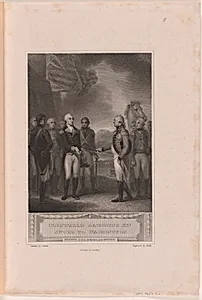
"The Columbiad" -- Cornwallis Resigning his Sword to Washington
Medium
Classification
Department
Smithsonian Collection
Museum
Smithsonian American Art Museum
Credit
National Portrait Gallery, Smithsonian Institution; gift of Mr. and Mrs. Joel Barlow
Accession Number
AD/NPG.79.19.i
Rights
Public Domain
Tags
Art Historical Context
Behold the dramatic moment captured in James Heath's 1807 *The Columbiad -- Cornwallis Resigning his to Washington*, a stirring engraving from the Smithsonian American Art Museum. British engraver James Heath (1757–1834), renowned for his meticulous historical illustrations, depicts the climactic surrender at Yorktown in 1781. General Charles Cornwallis, 1st Marquis and 2nd Earl, symbolically hands his sword to George Washington, the victorious American commander, amid a military camp with fortress walls, horses, and—hallmarks of Revolutionary War imagery. This scene commemorates the pivotal event that effectively ended the American Revolution, securing independence from Britain. Created as an illustration for Joel Barlow's epic poem *The Columbiad*, which celebrated America's rise, the print underscores national pride and heroism. Washington's stoic presence evokes his roles as soldier, surveyor, and future president, while Cornwallis's gesture highlights the triumph of colonial resolve. As a print, Heath's work exemplifies early 19th-century engraving techniques, allowing widespread dissemination of patriotic narratives when paintings were rare luxuries. Gifted by Mr. and Mrs. Joel Barlow to the National Portrait Gallery, it remains a cultural touchstone, inviting visitors to reflect on the forge of a new nation.