
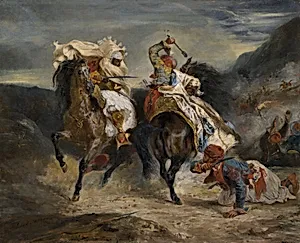
The Combat of the Giaour and Hassan
1826
Medium
Oil on canvas
Dimensions
59.6 × 73.4 cm (23 1/2 × 28 7/8 in.); Framed: 87.4 × 101.3 cm (34 3/8 × 39 7/8 in.)
Classification
oil on canvas
Department
Painting and Sculpture of Europe
Museum
Art Institute of Chicago
Accession Number
110663
Rights
Public Domain
About this artwork
For this frenetic scene, Eugène Delacroix took inspiration from “The Giaour,” a poem in a popular series of romantic tales by the celebrated English poet Lord Byron. Giaour is a derogatory Turkish word for a Christian or non-Muslim applied here to the warrior at left clad in swirling white drapery. Amid a violent struggle, the Giaour is avenging the death of his lover at the hands of his opponent. Delacroix mirrored the two central figures and their horses as the Giaour is about to strike the fa...
Art Historical Context
Eugène Delacroix *The Combat of the Giaour and Hassan* (1826) captures a dramatic moment of conflict drawn from Lord Byron’s popular poem *The Giaour*. In this vivid oil on canvas, the French artist portrays the fierce clash between a Venetian warrior and a Turkish pasha, set against a turbulent landscape. Delacroix, a leading figure of the Romantic movement, uses swirling brushwork and intense contrasts of color to convey raw emotion and physical struggle rather than precise detail. Painted during the height of Europe’s fascination with the Greek War of Independence, the work reflects the period’s political sympathies and literary tastes. Delacroix frequently turned to exotic and literary subjects to explore themes of passion, freedom, and violence. The relatively small scale of the painting—roughly 24 by 29 inches—invites close viewing, allowing the dynamic poses and luminous highlights to draw viewers into the narrative tension. As an early example of Romantic Orientalism, the canvas demonstrates Delacroix’s innovative technique of building form through bold color rather than line, influencing later generations of artists. Today it remains a compelling testament to the 19th century’s blend of adventure, empathy, and artistic experimentation.
About the Artist
Eugène Delacroix · 1798–1863
Eugène Delacroix (1798–1863) stands as the defining figure of French Romanticism and a pivotal bridge to modernism. Born in Charenton-Saint-Maurice near Paris, he came from distinguished lineage—his mother descended from the prestigious Oeben-Riesener furniture dynasty, while persistent speculation suggested the statesman Talleyrand may have been his biological father, a theory supported by physic...