
The Confectioner
Medium
Etching
Dimensions
Sheet: 11 x 14 9/16 in. (27.9 x 37 cm) Plate: 10 1/4 × 13 5/16 in. (26.1 × 33.8 cm)
Classification
Prints
Department
Drawings and Prints
Museum
Metropolitan Museum of Art, New York, NY
Credit
Harris Brisbane Dick Fund, 1926
Accession Number
26.49.61
Rights
Public Domain
Tags
About this artwork
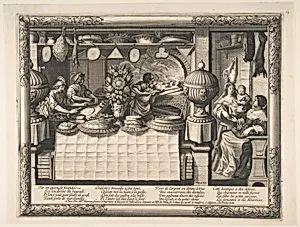
This etching presents a detailed view of a seventeenth-century Parisian confectioner's shop, capturing both the spatial arrangement of the establishment and the social interactions occurring within it. The composition shows the interior with careful attention to architectural details, display cases, and the activities of proprietor and customers, providing documentary evidence of commercial life in early modern Paris. Bosse renders the scene with the linear precision characteristic of his work, ...
Art Historical Context
Step into the bustling heart of 17th-century Paris with Abraham Bosse's etching *The Confectioner* (1632–35), a vivid snapshot of a confectioner's shop alive with activity. The scene captures the shop's intricate interior—display cases brimming with sweets, architectural details, and lively interactions between the proprietor, customers, men, women, and children. Rabbits, flowers, baskets, and vessels add charming touches, while figures busy themselves with cooking and working, offering a documentary glimpse into early modern commercial life and the era's confectionery trade. Bosse, a masterful French printmaker and perspective theorist (1602–1676), rendered this with his signature linear precision, using parallel lines and cross-hatching to build tonal depth and spatial illusion. Published by royal engraver Melchior Tavernier, it belongs to Bosse's encyclopedic series on Parisian professions, blending observation with geometric accuracy. The etching medium—acid etching lines into a copper plate—enabled the fine details perfect for complex interiors. This print wasn't just art; it preserved everyday trades for posterity, served as artist references, and provided affordable images celebrating middle-class life. A testament to Bosse's influence, it highlights how 17th-century prints bridged documentation, education, and delight. (198 words)
About the Artist
Abraham Bosse|Melchior Tavernier · 1602–1676
Abraham Bosse (1604–1676) was a French printmaker and theorist whose approximately 1,600 etchings provide an unparalleled visual record of 17th-century French life. Born to Huguenot parents in Tours, he trained in Paris under Melchior Tavernier and became a devoted follower of Jacques Callot's technical innovations. Bosse's meticulous etchings depicted subjects ranging from daily life and fashion ...