
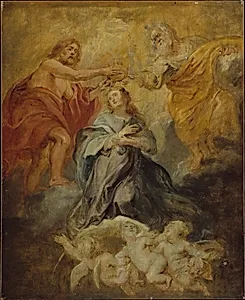
The Coronation of the Virgin
ca. 1632–33
Medium
Oil on wood
Dimensions
19 5/8 x 16 in. (49.8 x 40.6 cm)
Classification
Paintings
Department
European Paintings
Museum
Metropolitan Museum of Art, New York, NY
Credit
Bequest of Scofield Thayer, 1982
Accession Number
1984.433.336
Rights
Public Domain
Tags
Art Historical Context
Peter Paul Rubens, the preeminent Flemish Baroque master, painted *The Coronation of the* around 1632–33, capturing a triumphant moment in Christian iconography. Here, God the Father and crown the Virgin Mary as Queen of Heaven surrounded by celestial figures including men in dynamic poses. This small-scale oil on wood panel19⅝ × 16 in.) exemplifies Rubens' skill in devotional art, likely intended for private worship amid the Catholic Counter-Reformation's on emotional piety. Rubens' Baroque style shines through in the swirling composition, vibrant colors, and dramatic lighting that draw viewers into the divine drama. His loose, fluid brushwork—hallmarks of his mature period—conveys movement and spiritual ecstasy, contrasting the panel's intimate size with grand theatricality. Produced late in his career, it reflects his workshop's productivity and enduring influence on European religious painting. Now at the Metropolitan Museum of Art through the 1982 bequest of Scofield Thayer, this gem invites contemplation of Mary's exalted role, blending theological depth with Rubens' sensual, life-affirming humanism. A perfect study in how Baroque art made heaven feel vividly close.
About the Artist
Peter Paul Rubens · 1577–1640
Peter Paul Rubens (1577-1640) stands as the most influential artist of the Flemish Baroque tradition and the greatest exponent of Baroque painting's dynamism, vitality, and sensuous exuberance. Born in Siegen, Westphalia, and raised in Antwerp, Rubens received a humanist education studying Latin and classical literature before pursuing artistic training under three masters: Tobias Verhaecht, Adam ...