
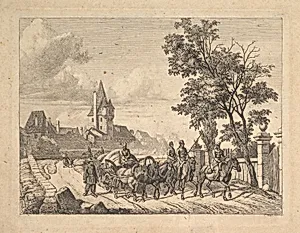
The Cossacks Escorting the Baggage Wagon
Medium
Etching; second state
Dimensions
plate: 6 1/4 x 8 1/8 in. sheet: 7 1/2 x 9 1/4 in.
Classification
Prints
Department
Drawings and Prints
Museum
Metropolitan Museum of Art, New York, NY
Credit
The Elisha Whittelsey Collection, The Elisha Whittelsey Fund, 1949
Accession Number
49.21.10
Rights
Public Domain
Tags
Art Historical Context
Johann Christoph Erhard's *The Cossacks Escorting Baggage Wagon* (1816) captures a dynamic moment of military movement amid the turbulent aftermath of the Napoleonic Wars Created as an etching in its second state—a refined impression from a revised plate—this print depicts fierce Cossack horsemen safeguarding a baggage wagon, surrounded by men, horses, carriages, trees, and distant buildings. The scene evokes the vast Russian steppes or war-torn European landscapes, where Cossacks renown as daring cavalry during campaigns against Napoleon's forces, including their legendary pursuit of the retreating Grande Armée in 1812. Erhard, a prolific German etcher known for his precise yet atmospheric landscapes and historical vignettes, masterfully employs etching techniques to convey motion and texture. Fine lines render the galloping horses' energy, the wagon's rugged form, and the subtle play of light through trees, drawing viewers into the chaos of wartime logistics. At just 6 1/4 x 8 1/8 inches (plate), this intimate work from The Metropolitan Museum of Art's Elisha Whittelsey Collection highlights etching's power as an accessible medium for disseminating vivid war imagery to a European audience hungry for heroic narratives. This piece not only documents a pivotal era but also showcases early 19th-century printmaking's role in shaping public memory of conflict, blending documentary realism with dramatic flair.
About the Artist
Johann Christoph Erhard · 1795–1822
Johann Christoph Erhard (1795–1822) was a German painter and etcher of the Romantic era whose sensitive landscape studies and skillful prints earned him a growing reputation before his tragically early death at twenty-six. Born in Nuremberg, he studied at the Nuremberg Academy and later in Munich, where he was influenced by the Romantic landscape tradition and the revival of interest in the art of...