
The Cossacks Escorting the Baggage Wagon
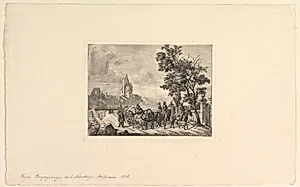
Medium
Etching; second state
Dimensions
plate: 6 1/8 x 8 in. sheet: 11 x 17 1/2 in.
Classification
Prints
Department
Drawings and Prints
Museum
Metropolitan Museum of Art, New York, NY
Credit
The Elisha Whittelsey Collection, The Elisha Whittelsey Fund, 1949
Accession Number
49.21.26
Rights
Public Domain
Tags
Art Historical Context
Visitors to the Metropolitan Museum of Art will find "The Cossacks Escorting Baggage Wagon" (1816) a dynamic etching by Johann Christoph Erhard, a prolific German printmaker known for his intricate landscapes and historical vignettes. This second-state impression, with a plate size of 6 1/8 x 8 inches, captures Cossacks—elite Russian cavalry renowned for their horsemanship—guiding a baggage wagon through a wooded scene. The tags of horses, military figures, and trees underscore the's focus on motion and natural surroundings. Created shortly after the Napoleonic Wars, the print reflects the era's lingering military fervor, evoking the Cossacks' celebrated role in Russia's campaigns against Napoleon. Erhard's etching technique, involving acid-etched lines on a metal plate, allowed for precise detailing of the horses' musculature, soldiers' uniforms, and branching foliage, achieving depth and texture in this intimate format. Housed in the Drawings and Prints department through The Elisha Whittelsey Collection (1949), this work highlights early 19th-century printmaking's power to preserve fleeting wartime narratives, blending artistry with historical witness for modern audiences.
About the Artist
Johann Christoph Erhard · 1795–1822
Johann Christoph Erhard (1795–1822) was a German painter and etcher of the Romantic era whose sensitive landscape studies and skillful prints earned him a growing reputation before his tragically early death at twenty-six. Born in Nuremberg, he studied at the Nuremberg Academy and later in Munich, where he was influenced by the Romantic landscape tradition and the revival of interest in the art of...