
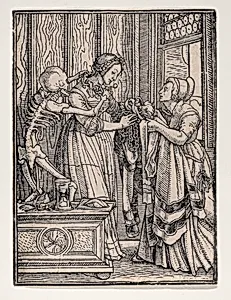
The Countess, from The Dance of Death
ca. 1526, published 1538
Medium
Woodcut
Dimensions
sheet: 2 9/16 x 1 7/8 in. (6.5 x 4.8 cm)
Classification
Prints
Department
Drawings and Prints
Museum
Metropolitan Museum of Art, New York, NY
Credit
Rogers Fund, 1919
Accession Number
19.57.33
Rights
Public Domain
Tags
Art Historical Context
In Hans Holbein the Younger's renowned *Dance of Death* series,The Countess* (ca. 1526, 1538) captures chilling inevitability of mortality through a masterful woodcut, meticulously cut by Hans Lützel. This tiny print (just 2 9/16 x 1 7/8 inches) belongs to a sequence of 41 illustrations that personify Death as a skeleton dancing with figures from every social stratum, from peasants to nobles. Here, a richly dressed countess pauses amid her finery, confronted by Death wielding an hourglass—a poignant symbol of fleeting time. Holbein's Northern Renaissance style shines in the intricate details: flowing fabrics, expressive faces, and skeletal menace rendered with sharp precision typical of woodcuts. This relief printing technique, where images are carved into wood blocks and inked for reproduction, made such moral allegories accessible to a wide audience via books, democratizing art during the early Reformation era. As a memento mori staple, *The Countess* underscores the medieval "Danse Macabre" tradition, reminding viewers—especially in plague-ridden Europe—that death levels all ranks. Housed in the Metropolitan Museum of Art's Drawings and Prints department (Rogers Fund, 1919), it invites us to reflect on life's transience with both dread and dark humor.