
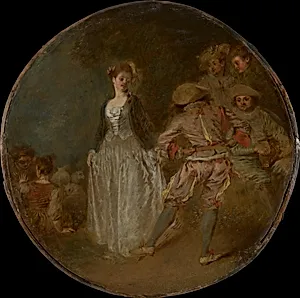
The Country Dance
Medium
Oil on wood
Dimensions
Diameter 8 1/2 in. (21.6 cm)
Classification
Paintings
Department
European Paintings
Museum
Metropolitan Museum of Art, New York, NY
Credit
Bequest of Lillian S. Timken, 1959
Accession Number
60.71.20
Rights
Public Domain
Tags
Art Historical Context
Antoine Watteau’s *The Country Dance* captures a lively outdoor gathering where elegantly dressed men and women move together in graceful steps. As a leading figure of the early eighteenth-century Rococo movement, Watteau specialized in *fêtes galantes*—poetic scenes of leisure that blend aristocratic refinement with rustic charm. Though the exact date remains unknown, the painting reflects the period’s fascination with fleeting pleasures and harmonious social rituals. Painted in oil on a small circular wooden panel just over eight inches across, the work invites intimate viewing. Watteau’s delicate brushwork and luminous palette bring vitality to the dancers’ flowing garments and the surrounding landscape, creating a sense of spontaneous movement within a carefully balanced composition. Such portable roundels were often prized for private collections, allowing viewers to savor the artist’s light-filled vision of joy and camaraderie. Today in the Metropolitan Museum of Art, this charming scene continues to illustrate Watteau’s gift for transforming everyday diversions into timeless celebrations of human connection.
About the Artist
Antoine Watteau · 1684–1721
Jean-Antoine Watteau, born in 1684 in Valenciennes to a modest family—his father a roofer named Jean-Philippe Watteau—was the second of four sons who displayed an early passion for art. After initial apprenticeship under local painter Jacques-Albert Gérin, he moved to Paris around 1702, working in workshops copying Flemish and Dutch genre scenes. By 1705, he entered the studio of Claude Gillot, ab...