
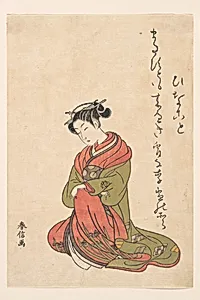
青楼美人合|The Courtesan Itsuhata with Her Pipe
ca. 1765
Medium
Woodblock print (Yonkyokuban); ink and color on paper
Dimensions
8 3/8 x 5 3/4 in. (21.3 x 14.6 cm)
Classification
Prints
Culture & Period
Japan · Edo period (1615–1868)
Department
Asian Art
Museum
Metropolitan Museum of Art, New York, NY
Credit
Henry L. Phillips Collection, Bequest of Henry L. Phillips, 1939
Accession Number
JP2769
Rights
Public Domain
Tags
Art Historical Context
Suzuki Harunobu's *The Courtesan Itsata with Her Pipe*ca. 1765) captures the alluring world of Edo-period Japan's pleasure districts. This intimate woodblock print depicts a courtesan, likely from the famed Yoshiwara quarter in Edo (modern Tokyo), lounging with her pipe in a moment of refined elegance. Harunobu a master of uki-e—the "pictures of the floating world" genre—pioneered full-color nishiki-e prints around this time, bringing vibrant life to scenes of beauty, theater, and urban leisure during the prosperous Edo period (1615–1868). Printed in the compact yonkyokuban format (8 3/8 x 5 3/4 in.), originally used for kabuki theater programs, this ink-and-color-on-paper work showcases Harunobu's innovative technique: multiple woodblocks for layering delicate hues, from soft pinks on the courtesan's kimono to subtle gradients in her skin and surroundings. Its small scale made such prints affordable and collectible, democratizing art for everyday admirers. A gem from the Metropolitan Museum of Art's Henry L. Phillips Collection, this piece highlights the cultural reverence for bijin-ga (images of beautiful women), blending sensuality with poetic poise. Visitors will appreciate how Harunobu elevated everyday elegance into timeless allure.
About the Artist
Suzuki Harunobu · 1725–1770
Suzuki Harunobu (c. 1725-1770) was a Japanese ukiyo-e artist who revolutionized woodblock printing by developing nishiki-e—full-color prints using multiple woodblocks—in 1765. Before Harunobu, Japanese prints were limited to two or three colors; his innovation unleashed the entire artist's palette, transforming ukiyo-e into the vibrant art form that would later captivate Western artists from Manet...