
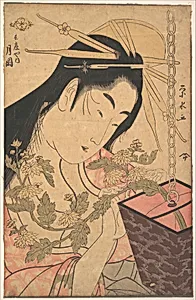
The Courtesan Tsukioka of Hyōgoya
Medium
Woodblock print; ink and color on paper
Dimensions
Image: 14 15/16 x 9 11/16 in. (37.9 x 24.6 cm)
Classification
Prints
Culture & Period
Japan · Edo period (1615–1868)
Department
Asian Art
Museum
Metropolitan Museum of Art, New York, NY
Credit
H. O. Havemeyer Collection, Bequest of Mrs. H. O. Havemeyer, 1929
Accession Number
JP1793
Rights
Public Domain
Tags
Art Historical Context
Behold *The Courtesan Tsoka of Hyōgoya*, a captivating woodblock print by Ichirakutei Eisui, a master of Japan's Edo period (1615–8). This ink and color on paper work, measuring nearly 15 by 10 inches, exemplifies *bijin-ga*—prints celebrating the refined beauty of women. Eisui, a pupil of the renowned Kitagawa Utamaro, specialized in elegant portrayals of courtesans, capturing their poise and allure amid the "floating world" (*ukiyo*) of urban pleasures in Edo (modern Tokyo). Created through the intricate ukiyo-e woodblock process—where artisans carved blocks for each color layer—this print highlights the technical brilliance of Japanese printmaking. Tsukioka, likely from the famed Hyōgoya house in the Yoshiwara pleasure district, is depicted with flowers and plants, symbols of fleeting beauty and seasonal elegance in Japanese culture. Such images were affordable art for the masses, reflecting society's fascination with geisha and courtesans as icons of sophistication. Part of the Metropolitan Museum of Art's H. O. Havemeyer Collection (bequest 1929), this piece offers a window into Edo Japan's vibrant social life, where art blurred lines between entertainment and high culture. A testament to enduring feminine grace!