
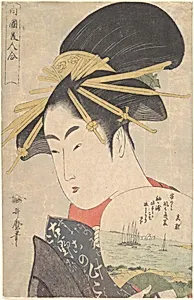
喜多川歌麿画 「南国美人合」 此すミ|The Courtesan Konosumi, from the series “Beauties of the Southern Quarter”(Nangoku bijin awase)
ca. 1793–94
Medium
Woodblock print; ink and color on paper
Dimensions
14 1/2 x 9 5/16 in. (36.8 x 23.7 cm)
Classification
Prints
Culture & Period
Japan · Edo period (1615–1868)
Department
Asian Art
Museum
Metropolitan Museum of Art, New York, NY
Credit
Rogers Fund, 1922
Accession Number
JP1367
Rights
Public Domain
Tags
About this artwork
The Courtesan Konosumi, from the series “Beauties of the Southern Quarter”(Nangoku bijin awase) is a prints by Japanese artist Kitagawa Utamaro, created in ca. 1793–94. The work was created using woodblock print; ink and color on paper. It measures 14 1/2 x 9 5/16 in. (36.8 x 23.7 cm). This piece represents the artistic traditions of Japan, Edo period (1615–1868), embodying the aesthetic values and technical expertise of its makers. Printmaking during this period was an essential medium for diss...
Art Historical Context
In the vibrant world of Edo-period Japan (1615–1868), Kitagawa Utam captured the allure of the *yūjo*—elegant courtesans from the Yoshiwara pleasure district—in his exquisite woodblock print *The Courtesan Konumi, from the series “Beauties of the Southern Quarter” (Nangoku bijin awase)*, created around 1793–94. Utamaro, a master of *ukiyo-e* (“pictures of the floating world”), specialized in *bijin-ga* portraits of beautiful women, rendering Konosumi with graceful poise, her fan delicately poised, evoking the refined sensuality of urban life in old Edo (modern Tokyo). This *ōban* print, measuring 14½ × 9⅜ inches, showcases the collaborative genius of woodblock printing: carvers sculpted intricate blocks from cherry wood, printers layered vibrant inks in precise colors, and artisans burnished the paper for a luminous finish. Affordable yet collectible, these prints democratized art, adorning homes and sparking admiration among merchants, samurai, and connoisseurs alike. Housed in the Metropolitan Museum of Art's Asian Art department since 1922 via the Rogers Fund, this piece preserves the cultural pulse of Japan's “floating world,” where beauty, transience, and artistry intertwined, offering visitors a window into an era of bold aesthetic innovation.
About the Artist
Kitagawa Utamaro · 1753–1806
Kitagawa Utamaro (c. 1753-1806) was one of the most celebrated masters of ukiyo-e woodblock printing, revolutionizing the art of bijin-ga (pictures of beautiful women) during Japan's Edo period. Born Kitagawa Ichitaro, his early life remains shrouded in mystery, with conflicting accounts placing his birth in Kyoto, Osaka, Yoshiwara in Edo (modern Tokyo), or Kawagoe in Musashi Province. Under the t...