
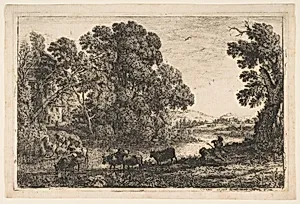
The Cowherd
Medium
Etching; third state of six (Mannocci)
Dimensions
Sheet: 5 1/2 x 8 1/4 in. (14 x 21 cm) Plate: 5 1/8 x 7 7/8 in. (13 x 20 cm)
Classification
Prints
Department
Drawings and Prints
Museum
Metropolitan Museum of Art, New York, NY
Credit
Harris Brisbane Dick Fund, 1937
Accession Number
37.3.14
Rights
Public Domain
Tags
Art Historical Context
Claude Lorrain's *The Cowherd* (1636) is a delicate etching that captures the artist's mastery of pastoral landscapes, evoking the serene beauty of the Roman countryside he so admired. Created in the third state of six, as cataloged by Mannocci, print measures a modest 5 1/2 x 8 1/4 inches and exemplifies Lorrain's early experimentation with etching—a technique where acid etches intricate lines into a copper plate, allowing for subtle tonal variations and atmospheric depth. Working in 17th-century France but deeply influenced by his time in Italy, Lorrain pioneered the classical landscape genre, blending real observation with idealized harmony. In this scene, a lone cowherd tends to grazing cattle along a winding river, framed by lush hills and distant trees under a vast sky. The composition draws viewers into a timeless idyll, with Lorrain's signature use of light filtering through foliage to create glowing effects and a sense of infinite space. Etchings like this were revolutionary, making his luminous visions accessible beyond oil paintings to collectors across Europe. Housed in the Metropolitan Museum of Art's Drawings and Prints department, thanks to the Harris Brisbane Dick Fund of 1937, *The Cowherd* highlights Lorrain's enduring influence on later Romantic artists like Turner, inviting us to pause and savor nature's quiet poetry.
About the Artist
Claude Lorrain (Claude Gellée) · 1604–1682
Claude Gellée was born around 1600 in the village of Chamagne in the Duchy of Lorraine, from which he would take the professional name by which history knows him: Claude Lorrain. Orphaned young, he traveled south to Rome as a teenager, eventually finding his way into the Naples workshop of Goffredo Wals before apprenticing with the Roman landscapist and fresco painter Agostino Tassi around 1622. F...