
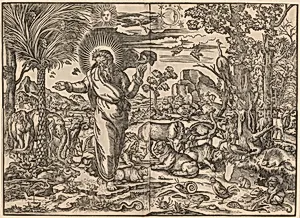
The Creation of the Animals
Medium
woodcut from four blocks on laid paper
Dimensions
sheet: 49 × 57.8 cm (19 5/16 × 22 3/4 in.)
Classification
Department
CG-E
Museum
National Gallery of Art, Washington, D.C.
Credit
Ruth and Jacob Kainen Memorial Acquisition Fund
Accession Number
2022.67.1
Rights
Public Domain
Art Historical Context
"The Creation of the Animals," a large woodcut produced around 1550 by an anonymous Venetian artist after a design by Raphael, captures a moment of divine wonder from the Book of Genesis. Created roughly three decades after Raphael’s death, the print reflects the enduring influence of the High Renaissance master, whose graceful figures and harmonious compositions continued to inspire artists across Italy. By translating Raphael’s vision into print, the Venetian workshop made this biblical scene accessible to a broader audience beyond the walls of churches and palaces. The work’s impressive scale—nearly two feet across—was achieved through an ambitious technique using four separate woodblocks printed on a single sheet of laid paper. This multi-block method allowed for greater detail and tonal range than typical single-block woodcuts, demonstrating the technical sophistication of sixteenth-century Venetian printmaking. Such large-format prints played a vital role in spreading artistic ideas throughout Europe, serving both as devotional objects and as models for painters and collectors. Today, this impression in the National Gallery of Art’s collection highlights how Renaissance designs lived on through reproductive prints, bridging the worlds of painting and graphic art for generations of viewers.