
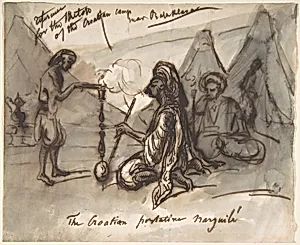
The Croatian Potentate Narguile
1817–92
Medium
Pen and brown ink with brush and gray and brown washes
Dimensions
sheet: 6 9/16 x 8 in. (16.7 x 20.3 cm)
Classification
Drawings
Department
Drawings and Prints
Museum
Metropolitan Museum of Art, New York, NY
Credit
Gift of Anne K. Jones, in memory of Edward Powis Jones, 2003
Accession Number
2003.388.3
Rights
Public Domain
Tags
Art Historical Context
Behold *The Croatian Potentate Narguile*, a ink drawing by Constantin Guys (1805–1892), the French artist celebrated by Charles Baudelaire as the "ainter of modern life." with pen and brown ink heightened by brush and gray and washes on a modest sheet measuring 6 9/16 x 8 inches, this work exemplifies Guys' masterful quick-sketch technique. His fluid lines and subtle tonal washes evoke immediacy, capturing fleeting moments of 19th-century society with journalistic verve. The title spotlights a Croatian potentate—likely a noble or ruler—indulging in a narguile, or hookah, a symbol of Eastern leisure and exoticism popular in European imagination during Guys' era. Tags noting "Men" and "Smoking" underscore the intimate focus on this solitary figure, blending portraiture with cultural observation. Guys, who chronicled Parisian boulevards, military parades, and cosmopolitan characters during his travels (including the Crimean War), infused his drawings with vibrant energy, prefiguring Impressionism's spontaneity. Housed in the Metropolitan Museum of Art's Drawings and Prints department (gift of Anne K. Jones, 2003), this piece invites us to ponder cross-cultural encounters in an age of empire and exploration. Guys' economical medium highlights the potentate's dignified poise amid swirling smoke, offering a window into the diverse tapestry of mid-19th-century life.
About the Artist
Constantin Guys · 1802–1892
Constantin Guys, born Ernest-Adolphe-Hyacinthe-Constantin Guys de Saint-Hélène on December 3, 1802, in Vlissingen, Netherlands, to French parents François Lazare Guys and Elisabeth Bétin, spent his early years in a naval family that relocated to Calais around 1805. His early life is not well documented, with no records of formal art training, teachers, or schools; Guys appears to have been largely...