
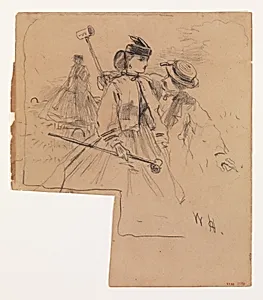
The Croquet Players
1866
Medium
Conté crayon, on tan wove paper
Dimensions
11 1/2 x 10 1/8 in. (29.2 x 25.7 cm)
Classification
Drawing
Culture
American
Department
The American Wing
Museum
Metropolitan Museum of Art, New York, NY
Credit
Fletcher Fund, 1937
Accession Number
37.98
Rights
Public Domain
Tags
Art Historical Context
Winslow Homer's *The Croquet Players*1866) captures a moment of leisurely recreation in post-Civil War, a time when the nation sought normalcy amid reconstruction. Created just after the war's end, this intimate drawing reflects Homer's growing fascination with everyday American life shifting from his earlier battlefield illustrations to vibrant genre scenes. Croquet, a fashionable outdoor game introduced to the U.S. in the 1860s, symbolized emerging middle-class leisure and social mingling between men and women, as hinted by the artwork's tags. Rendered in conté crayon on tan wove paper—a medium prized for its rich tonal range and bold lines—Homer employs loose, expressive strokes to convey movement and light. Measuring just 11½ x 10⅛ inches, this sketch exemplifies his masterful draftsmanship, blending realism with a fresh, spontaneous energy that foreshadowed his later watercolor innovations. As a key figure in American realism, Homer elevated ordinary subjects into profound statements on national identity. Housed in The Metropolitan Museum of Art's American Wing (Fletcher Fund, 1937), this work invites visitors to appreciate how Homer chronicled a healing society through simple joys, bridging fine art and popular culture.
About the Artist
Winslow Homer · 1836–1910
Winslow Homer (1836-1910) was one of America's greatest painters and a preeminent figure in 19th-century American art. Largely self-taught, Homer began his career as a commercial illustrator and Civil War correspondent for Harper's Weekly before becoming renowned for his powerful marine subjects and landscape paintings. His mastery of both oil and watercolor, combined with his uncompromising reali...