
The Crucifixion
c. 1430
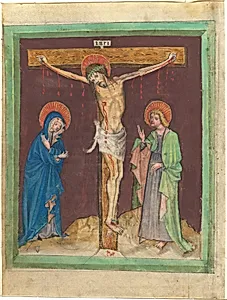
Medium
miniature on vellum
Dimensions
overall: 20.2 x 15.3 cm (7 15/16 x 6 in.)
Classification
Drawing
Department
CG-E
Museum
National Gallery of Art, Washington, D.C.
Credit
Rosenwald Collection
Accession Number
1949.5.80
Rights
Public Domain
Art Historical Context
Nestled in the Rosenwald Collection at the National Gallery of Art, *The Crucifixion* a delicate miniature on vellum created by an Austrian artist around 1430. Measuring just 20.2 x 15.3 cm, this intimate work exemplifies the exquisite craftsmanship of Late Gothic manuscript illumination in Central Europe. Vellum, made from animal skin, provided a luminous surface ideal for vibrant pigments and gold leaf, allowing the scene to glow with spiritual intensity during private devotion. Depicting Christ's Crucifixion—a pivotal moment in Christian theology—the miniature captures the raw emotion and theological depth central to 15th-century religious art. Austrian illuminators during this era blended intricate detail with expressive figures, influenced by the International Gothic style's graceful lines and rich symbolism. Such works often adorned Books of Hours or prayer books, serving as personal aids for meditation on Christ's sacrifice amid the devotional fervor of the late Middle Ages. This classification as a drawing underscores its masterful linear technique and subtle modeling, inviting viewers to contemplate its historical role in fostering piety. A testament to anonymous artistry, it bridges the medieval and early Renaissance worlds, offering a window into the spiritual life of its time.