
The Crucifixion
in or before 1509
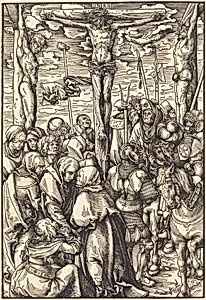
Medium
woodcut
Classification
Department
CG-E
Museum
National Gallery of Art, Washington, D.C.
Credit
Rosenwald Collection
Accession Number
1950.1.49
Rights
Public Domain
Art Historical Context
**The Crucifixion** by Lucas Cranach the, created in or before 150, captures one of Christianity's most profound moments through the bold medium of woodcut. early print from the German Renaissance master depicts Christ's suffering on the cross, surrounded by mourning figures, exemplifying Cranach's skill in conveying deep emotion with stark contrasts and intricate details. Housed in the National Gallery Art's Rosenwald CollectionDepartment CG-E), it reflects the era's growing accessibility of religious art via printmaking. Cranach (1472–1553), a key figure in the Northern Renaissance, blended meticulous line work with dramatic composition, influenced by his training in Vienna and patronage by Saxon courts. Woodcuts like this were revolutionary: carved into wood blocks and printed on paper, they enabled widespread dissemination of devotional images at a time when the printing press was transforming Europe. Before 1509, such prints served pilgrims and the faithful, fostering personal piety amid the late Gothic to Renaissance shift. This work's cultural weight lies in its role bridging medieval tradition and emerging Reformation ideas—Cranach later became a Lutheran ally. Its survival highlights woodcuts' durability, inviting modern viewers to ponder faith's visual power in a pre-digital age. (198 words)
About the Artist
Lucas Cranach the Elder · 1472–1553
Lucas Cranach the Elder (c. 1472-1553) was one of the most prominent German Renaissance painters and a key artistic figure of the Protestant Reformation. Born in Kronach, Franconia, to the painter Hans Maler, Cranach began his career in Vienna around 1502, where he became one of the founders of the Danube School, a movement characterized by expressive landscape painting and emotional force. His ea...