
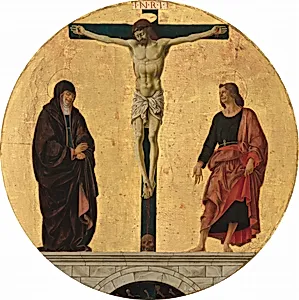
The Crucifixion
c. 1473/1474
Medium
tempera on poplar panel
Dimensions
overall (diameter of painted surface): 60 × 63.2 cm (23 5/8 × 24 7/8 in.) framed: 103.51 × 102.87 × 18.42 cm (40 3/4 × 40 1/2 × 7 1/4 in.)
Classification
Painting
Department
CIS-R
Museum
National Gallery of Art, Washington, D.C.
Credit
Samuel H. Kress Collection
Accession Number
1952.5.5
Rights
Public Domain
Art Historical Context
**The Crucifixion** by Francesco del Cossa painted around 1473–1474, is a striking circular tondo in tempera on poplar, measuring about 60 cm in diameter. Housed in the National Gallery of Art part of the Samuel H. Kress Collection, devotional work captures the pivotal Christian scene of Christ's death on the cross, rendered with the vivid clarity typical of Ferrarese Renaissance art. Del Cossa, a leading painter from Ferrara in northern Italy, was renowned for his contributions to the Este court's opulent decorations, including the Palazzo Schifanoia's frescoes. The tondo format—popular in Renaissance Italy for intimate home altars—allowed del Cossa to compose a balanced, harmonious scene within a perfect circle, emphasizing symmetry and emotional depth. Tempera, an egg-yolk-based medium, lent the painting its luminous colors and fine detail, bridging medieval traditions with emerging Renaissance naturalism. Though oil was gaining favor elsewhere, tempera's precision suited del Cossa's meticulous style. This artwork reflects Ferrara's cultural flourishing under ducal patronage, blending piety with artistic innovation. Visitors are drawn to its poignant humanity, inviting quiet reflection on sacrifice and redemption in a compact, jewel-like form.