
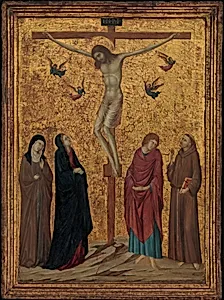
The Crucifixion
ca. 1315–20
Medium
Tempera on wood, gold ground
Dimensions
Overall, with engaged frame, 25 1/4 x 18 5/8 in. (64.1 x 47.3 cm), painted surface 22 1/4 x 15 3/4 in. (56.5 x 40 cm)
Classification
Paintings
Department
European Paintings
Museum
Metropolitan Museum of Art, New York, NY
Credit
Bequest of George Blumenthal, 1941
Accession Number
41.190.31a
Rights
Public Domain
Tags
Art Historical Context
Ugolino da Siena's *The Crucifixion*, painted around 1315–20, captures the poignant moment of Christ's sacrifice on the cross, surrounded by sorrowful figures including the Virgin Mary, Saint John the Evangelist, and the newly canonized Saint Francis of Assisi. This tempera-on-wood panel, with its shimmering gold ground, exemplifies the devotional art of early 14th-century Siena, a vibrant hub of Gothic painting rivaling Florence. Saint Francis's inclusion—likely depicted with stigmata—reflects his growing cult following, blending biblical narrative with contemporary piety. Ugolino, a follower of the master Duccio di Buoninsegna, employs the Sienese style's hallmark elegance: elongated figures with graceful drapery, expressive faces, and intricate gold tooling that evokes a heavenly glow. The gold leaf not only symbolizes divine light but also creates a luminous, otherworldly space, drawing worshippers into intimate contemplation during Mass. Housed in the Metropolitan Museum of Art, this work highlights Siena's artistic innovation in the Trecento period, bridging Byzantine influences with emerging naturalism. Its modest scale suggests it once adorned a private altar or predella, inviting personal devotion amid the era's religious fervor.
About the Artist
Ugolino da Siena · 1317–1349
Ugolino da Siena, also known as Ugolino di Nerio, was a pivotal figure in the early Sienese school of painting, active in Siena during the 1320s. Born around 1317, he came from a family of artists: his father, Nerio, and brothers Guido and Muccio were also painters, embedding him within a lineage that contributed to Siena's vibrant artistic community. Documented in Siena in 1325 and 1327, Ugolino'...