
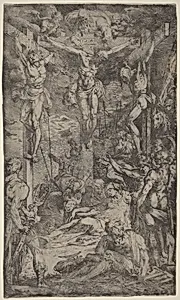
The Crucifixion
1501 to 1550
Medium
etching
Classification
Department
CG-E
Museum
National Gallery of Art, Washington, D.C.
Credit
Ailsa Mellon Bruce Fund
Accession Number
1972.65.27
Rights
Public Domain
Art Historical Context
Behold *The Crucifixion*, a poignant etching by the Florentine Mannerist artist Bernardino Poccetti created sometime between 1501 and1550. Poccetti, known for his dynamic frescoes and intricate designs in late Renaissance Florence, captured the solemn drama of Christ's crucifixion—a central motif in Christian art that evoked devotion and contemplation during the Counter-Reformation era. This print, housed in the National of Art's Department of Prints (CG-E), reflects the period's emphasis on emotional intensity and graceful figures characteristic of Mannerism. Etching, a revolutionary technique in the 16th century, involved coating a metal plate with acid-resistant ground, incising lines that the acid would etch into the surface, and printing from the inked plate. Poccetti's mastery of this medium allowed for fine, expressive lines that conveyed texture, shadow, and pathos, making sacred scenes accessible beyond elite patrons through affordable reproductions. Acquired via the Ailsa Mellon Bruce Fund, this work exemplifies how prints bridged art and faith, disseminating powerful religious narratives to a broader audience. Visitors will appreciate its technical precision and spiritual depth, a testament to Poccetti's versatility in translating grand themes into intimate formats. (198 words)
About the Artist
Bernardino Poccetti · 1548–1612
Italian late Renaissance fresco painter, Florence. Comment on works: religious; in Pilkington he is credited with flower paintings