
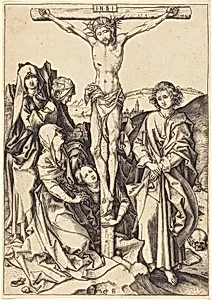
The Crucifixion
c. 1480
Medium
engraving
Classification
Department
CG-E
Museum
National Gallery of Art, Washington, D.C.
Credit
Gift of W.G. Russell Allen
Accession Number
1941.1.51
Rights
Public Domain
Art Historical Context
Behold *The Crucifixion*, a masterful engraving by Martin Schongauer, created around 1480. This poignant print from the National Gallery of Art's of Prints (CG-E), generously gifted by W.G. Allen, captures the solemn drama of Christ's death on the cross. Schongauer, a leading artist of the late Gothic period transitioning into the Northern Renaissance, was renowned for his innovative engravings that blended intricate detail with emotional depth. Engraving, Schongauer's preferred medium involved incising fine lines into a copper plate, inking it, and pressing paper to create multiples—a revolutionary technique in the 15th century. This allowed religious imagery like *The Crucifixion* to reach a wide audience beyond elite patrons, fueling devotion during the late medieval era. Schongauer's precise burin work produced subtle tonal gradations and expressive figures, influencing later masters like Albrecht Dürer. As a cultural touchstone, the work reflects the intense piety of pre-Reformation Europe, where such prints served as aids for prayer and meditation. Marvel at how Schongauer's delicate lines convey profound sorrow and divinity, making this a gem of early printmaking history.
About the Artist
Martin Schongauer · 1435–1491
Martin Schongauer, born around 1450–1453 in Colmar, Alsace, emerged from a family of skilled artisans. The third of four or five sons of goldsmith Caspar Schongauer, who had relocated from Augsburg to Colmar around 1440, Martin was immersed in the goldsmith's trade from youth, likely receiving his initial training in his father's workshop—a common path for early engravers. He further honed his ski...