
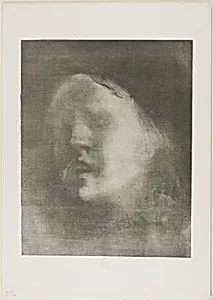
The Cry
1894
Medium
Lithograph in black on off-white China paper, laid down on white wove paper
Dimensions
Image/primary support: 32.5 × 25.6 cm (12 13/16 × 10 1/8 in.); Secondary support: 44.5 × 31.5 cm (17 9/16 × 12 7/16 in.)
Classification
lithograph
Department
Prints and Drawings
Museum
Art Institute of Chicago
Accession Number
72305
Rights
Public Domain
Art Historical Context
Eugène Carrière's *The Cry* (1894) is a haunting lithograph that exemplifies the French artist's mastery of subtle, emotive imagery. Created as a black lithograph on delicate off-white China paper, down on white wove paper, the work measures 32.5 × 25.6 cm for the primary image. Housed in the Art Institute of Chicago's Prints and Drawings department, it invites visitors to contemplate its intimate scale and moody atmosphere. Carrière, a prominent Symbolist working in late 19th-century Paris, favored soft-focus techniques to evoke dreams and inner emotions, often exploring themes of maternity and melancholy. Lithography, a planographic printing method using greasy crayon on stone, allowed him to achieve velvety blacks and tonal gradations that mimic his signature pastel-like paintings. This medium was revolutionary for its accessibility, enabling artists to produce multiple impressions while retaining painterly qualities. *The Cry* captures the fin-de-siècle fascination with psychological depth, its title suggesting raw human anguish rendered through shadowy forms. As a print, it democratized Carrière's vision, bridging elite painting with broader audiences and underscoring the era's shift toward expressive modernism. A poignant gem for print enthusiasts!
About the Artist
Eugène Carrière · 1849–1906
Eugène Carrière (1849–1906) was a French painter whose deeply personal and atmospheric canvases made him one of the most distinctive voices of the Symbolist generation. Born in Gournay-sur-Marne, Carrière trained at the École des Beaux-Arts in Paris under Alexandre Cabanel, though he quickly moved beyond the academic conventions he encountered there, forging an intensely individual manner that owe...