
The Dam Wood
1874/75
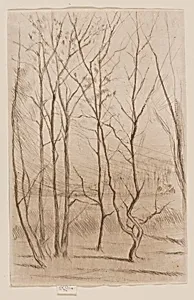
Medium
Drypoint in brown ink on off-white wove paper
Dimensions
Plate: 17.4 × 11.2 cm (6 7/8 × 4 7/16 in.); Sheet: 18 × 11.2 cm (7 1/8 × 4 7/16 in.)
Classification
drypoint
Department
Prints and Drawings
Museum
Art Institute of Chicago
Accession Number
73438
Rights
Public Domain
Art Historical Context
James McNeill Whistler, renowned 19th-century artist famous for his emphasis on tonal harmony and "art for art's sake," createdThe Dam Wood* around 1874–75. This intimate drypoint print, executed in brown ink on off-whiteove paper, captures the subtle beauty of a wooded landscape near a dam. Measuring just 17.4 × 11.2 cm on the plate, its small scale invites close viewing, revealing Whistler's masterful use of drypoint—a technique where the artist scratches directly into a metal plate, bypassing acid etching to produce rich, velvety lines and delicate tonal effects. Whistler's drypoints from this period marked a high point in his printmaking experiments, influenced by his admiration for Japanese art and Rembrandt's etchings. Unlike traditional narrative prints, *The Dam Wood* prioritizes mood and atmosphere over detail, reflecting the Aesthetic movement's focus on beauty and suggestion. Produced during a prolific phase in London, where Whistler navigated artistic scandals like the Ruskin libel trial, this work exemplifies his innovative push against Victorian realism. Housed in the Art Institute of Chicago's Prints and Drawings Department, *The Dam Wood* showcases the tactile allure of drypoint—each impression varies slightly due to ink buildup on the burrs raised by scratching. It's a gem for visitors appreciating how Whistler transformed humble paper into poetic evocations of nature.
About the Artist
James McNeill Whistler · 1834–1903
James Abbott McNeill Whistler (1834-1903) was an American-born painter and printmaker who became a leading figure in the Aesthetic Movement and pioneer of Tonalism and Japonisme. He revolutionized art by championing "art for art's sake" and treating paintings as visual equivalents of musical compositions, titling works as "arrangements," "harmonies," and "nocturnes" to emphasize formal qualities o...