
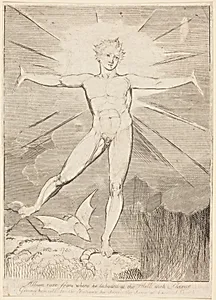
The Dance of Albion (Glad Day)
c. 1803/1810
Medium
engraving
Dimensions
image: 27 x 19.4 cm (10 5/8 x 7 5/8 in.) sheet: 30.8 x 23.2 cm (12 1/8 x 9 1/8 in.)
Classification
Department
CG-E
Museum
National Gallery of Art, Washington, D.C.
Credit
Rosenwald Collection
Accession Number
1943.3.8990
Rights
Public Domain
Art Historical Context
William Blake's *The Dance of Albion ( Day)*, created around 1803–1810, is a captivating engraving that exemplifies the artist's visionary genius. Measuring 27 x 19.4 cm, this print from the National Gallery of Art Rosenwald Collection depicts a radiant nude figure—often interpreted as Albion, Blake's mythic embodiment of England—with arms outstretched in ecstatic joy, surrounded by swirling rays of light. Blake, a pioneering Romantic artist, poet, and printmaker, blended mysticism, biblical themes, and personal mythology to challenge the rationalism of his era. Printed using Blake's innovative relief etching technique, the work allowed him to combine text and image in his "illuminated books," though this standalone engraving highlights his mastery of line and form. The dynamic pose evokes a dance of creation and spiritual awakening, drawing from Shakespearean and Miltonic influences, and reflects Blake's belief in humanity's divine imagination amid the Industrial Revolution's shadows. A beacon of Romantic individualism, *Glad Day* (its alternate title) invites viewers to embrace transcendent joy. Blake hand-colored many impressions, making each unique—discover its glowing vitality in the museum's prints department!
About the Artist
William Blake · 1757–1827
William Blake (1757–1827) stands as one of the most visionary and unconventional artists in British history, a poet-painter-printmaker whose mystical imagination and radical vision profoundly shaped the Romantic movement. Born in London's Soho district, Blake experienced visions from childhood—claiming to see angels in trees at age eight—and these spiritual encounters would guide his art throughou...