
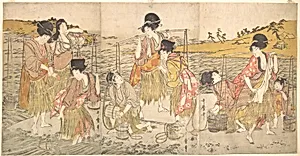
The Dance of the Beach Maidens
early 19th century
Medium
Triptych of woodblock prints; ink and color on paper
Dimensions
Overall: 15 1/4 x 29 1/2 in. (38.7 x 74.9 cm)
Classification
Prints
Culture & Period
Japan · Edo period (1615–1868)
Department
Asian Art
Museum
Metropolitan Museum of Art, New York, NY
Credit
H. O. Havemeyer Collection, Bequest of Mrs. H. O. Havemeyer, 1929
Accession Number
JP1683
Rights
Public Domain
Tags
Art Historical Context
Step into the vibrant world of Edo-period Japan with *The Dance of the Beach Maid*, a captivating triptych woodblock by the master Kitagawa Utamaro. in the early 19th century during the Edo period (161–1868), this exemplifies ukiyo-e, the "pictures of the floating world" that celebrated fleeting pleasures like beauty, nature, and entertainment. Utamaro, for his bijin-ga (images of beautiful women), portrays graceful maidens mid-dance along a sun-kissed beach their flowing kimonos and dynamic poses evoking joy and harmony with the sea. Printed with ink and color on paper, the triptych format—three sheets joined to form a panoramic 15¼ x 29½-inch scene—allows for an immersive composition. Woodblock printing, a hallmark of Japanese artistry, involved collaborative craftsmanship: carvers, printers, and publishers layering delicate colors to achieve luminous effects, from the soft waves to the women's expressive faces. This technique made such prints affordable and popular among urban dwellers in Edo (modern Tokyo). Housed in the Metropolitan Museum of Art's Asian Art Department as part of the H.O. Havemeyer Collection, the print highlights women's roles in cultural pastimes like dance, blending sensuality with poetic elegance. It invites us to appreciate how Utamaro captured ephemeral moments, preserving the spirit of Japan's pleasure districts for generations.
About the Artist
Kitagawa Utamaro · 1753–1806
Kitagawa Utamaro (c. 1753-1806) was one of the most celebrated masters of ukiyo-e woodblock printing, revolutionizing the art of bijin-ga (pictures of beautiful women) during Japan's Edo period. Born Kitagawa Ichitaro, his early life remains shrouded in mystery, with conflicting accounts placing his birth in Kyoto, Osaka, Yoshiwara in Edo (modern Tokyo), or Kawagoe in Musashi Province. Under the t...