
The Daughters of Minyas
Medium
Etching
Dimensions
10 1/4 x 12 3/16 in. (26.1 x 30.9 cm)
Classification
Prints
Department
Drawings and Prints
Museum
Metropolitan Museum of Art, New York, NY
Credit
The Elisha Whittelsey Collection, The Elisha Whittelsey Fund, 1949
Accession Number
49.97.583
Rights
Public Domain
Tags
Art Historical Context
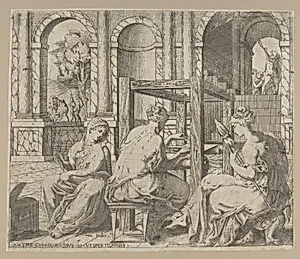
In the opulent world of Renaissance France, *The Daughters of Minyas (1545) captures a dramatic moment from Greek mythology. Created by Italian artists Antonio Fantuzzi and Francesco Primcio, who were key figures in the School of Fontaineble, the etching depicts the of King Minyas—Alcithoë, Leucippe, and Arsippe—defiantly weaving at their looms. In Ovid's *Metamorphoses*, they spurn the rites of Dionysus, the god of wine and ecstasy, choosing mortal tasks over divine revelry; as punishment, they are transformed into bats. The tags highlighting "Women" and "Looms" emphasize this tension between domestic labor and mythic transgression. This etching exemplifies the Mannerist style that Primaticcio and Fantuzzi brought to King Francis I's Fontainebleau Palace. Primaticcio's elegant designs, often reproduced in print by Fantuzzi, feature elongated figures, intricate patterns, and a sense of graceful movement, blending Italian sophistication with French decorative arts. Etching, a relatively new technique in the 16th century, allowed for delicate, fluid lines that mimicked drawing, making these prints ideal for disseminating courtly motifs to workshops across Europe. Housed in the Metropolitan Museum of Art's Drawings and Prints department (acquired via The Elisha Whittelsey Fund in 1949), this 10¼ × 12⅜-inch work (26.1 × 30.9 cm) reflects the era's fascination with classical myths as vehicles for artistic innovation. It invites visitors to ponder the clash of piety and passion in a visually poetic form.
About the Artist
Antonio Fantuzzi|Francesco Primaticcio · 1537–1545
**Antonio Fantuzzi** (active 1537–1550) was an Italian painter and printmaker born in Bologna who played a significant role in the First School of Fontainebleau during the French Renaissance. He worked in a Mannerist style, contributing to the lavish decorations of the Palace of Fontainebleau under royal patronage. Fantuzzi is recorded as a painter at Fontainebleau from 1537 onward, initially on ...