
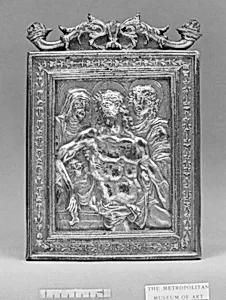
The Dead Christ Supported by the Virgin and St. John
16th century
Medium
Gilt bronze
Dimensions
4 1/2 × 3 1/4 in. (11.4 × 8.3 cm)
Classification
Medals and Plaquettes
Culture
Italian, Padua
Department
European Sculpture and Decorative Arts
Museum
Metropolitan Museum of Art, New York, NY
Credit
Rogers Fund, 1908
Accession Number
08.175.14
Rights
Public Domain
Tags
Art Historical Context
In the intimate glow of Renaissance devotion, *The Dead Christ Supported by the and St. John* a poignant Pietà moment, where the lifeless body of Christ is tenderly held by his grieving mother and the apostle St. John. Crafted by Galeazzo Mondella, known Moderno, this th-century gilt bronze plaquette hails from Padua, Italy—a hub of innovative bronze casting. Measuring just 4½ × 3¼ inches, its small scale made it perfect for private prayer, collecting, or wearing as a pendant, blending sacred imagery with the era's fascination for classical antiquity. Moderno, a master of medals and plaquettes, drew from antique Roman coins to create these low-relief sculptures, gilding the bronze for a luminous, jewel-like effect that heightened emotional depth. Produced around 1500–1530, such works reflect the Renaissance revival of humanism and piety, where everyday objects became vehicles for profound spirituality. Acquired through the Rogers Fund in 1908, this piece now graces the Metropolitan Museum of Art's European Sculpture and Decorative Arts collection, exemplifying Padua's technical prowess in metalwork and its cultural role in disseminating religious iconography to a broader audience.
About the Artist
Moderno (Galeazzo Mondella) · 1467–1528
Moderno, identified by scholars as the goldsmith and medallist Galeazzo Mondella (c. 1467–c. 1528), was among the most gifted Italian artists working in small-scale bronze and lead relief at the turn of the sixteenth century. The pseudonym Moderno, meaning simply "the modern one," signals both the esteem in which his contemporaries held his work and his own conscious alignment with the revival of ...