
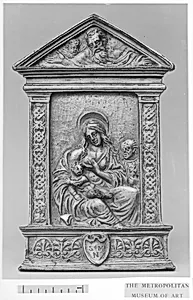
Virgin and Child with St. Joseph
mid-16th century
Medium
Gilt bronze
Dimensions
4 3/8 × 2 7/8 in. (11.1 × 7.3 cm)
Classification
Medals and Plaquettes
Culture
Italian, Padua
Department
European Sculpture and Decorative Arts
Museum
Metropolitan Museum of Art, New York, NY
Credit
Rogers Fund, 1908
Accession Number
08.189.2
Rights
Public Domain
Tags
Art Historical Context
In the tranquil glow of Renaissance Italy, Galeazzo Mondella, known Moderno, crafted this exquisite *Virgin and Child with St. Joseph* the mid-16th century. Hailing from Padua, a hub of artistic innovation, Moderno was a master medallist renowned for his intricate bronze reliefs. This small gilt bronze plaquette, measuring just 4 3/8 × 2 7/8 inches, captures the holy family in a tender, intimate composition: the Virgin Mary cradles the Christ Child, while St. Joseph stands protectively nearby, embodying the era's deep devotion to sacred themes. Gilt bronze was a prized medium for plaquettes like this—affordable yet luxurious devotional objects popular among collectors and the devout. The gilding adds a heavenly luminescence, enhancing the fine chasing and modeling that define Moderno's Renaissance style, influenced by classical antiquity and northern European prints. Produced in Padua's vibrant workshops, such works bridged sculpture and printmaking, serving as portable altarpieces or cabinet treasures. Today, housed in the Metropolitan Museum of Art's European Sculpture and Decorative Arts department (Rogers Fund, 1908), this piece offers a window into 16th-century piety and artistry. Its modest scale belies its cultural weight, reminding us how everyday objects carried profound spiritual resonance in Renaissance life.
About the Artist
Moderno (Galeazzo Mondella) · 1467–1528
Moderno, identified by scholars as the goldsmith and medallist Galeazzo Mondella (c. 1467–c. 1528), was among the most gifted Italian artists working in small-scale bronze and lead relief at the turn of the sixteenth century. The pseudonym Moderno, meaning simply "the modern one," signals both the esteem in which his contemporaries held his work and his own conscious alignment with the revival of ...